



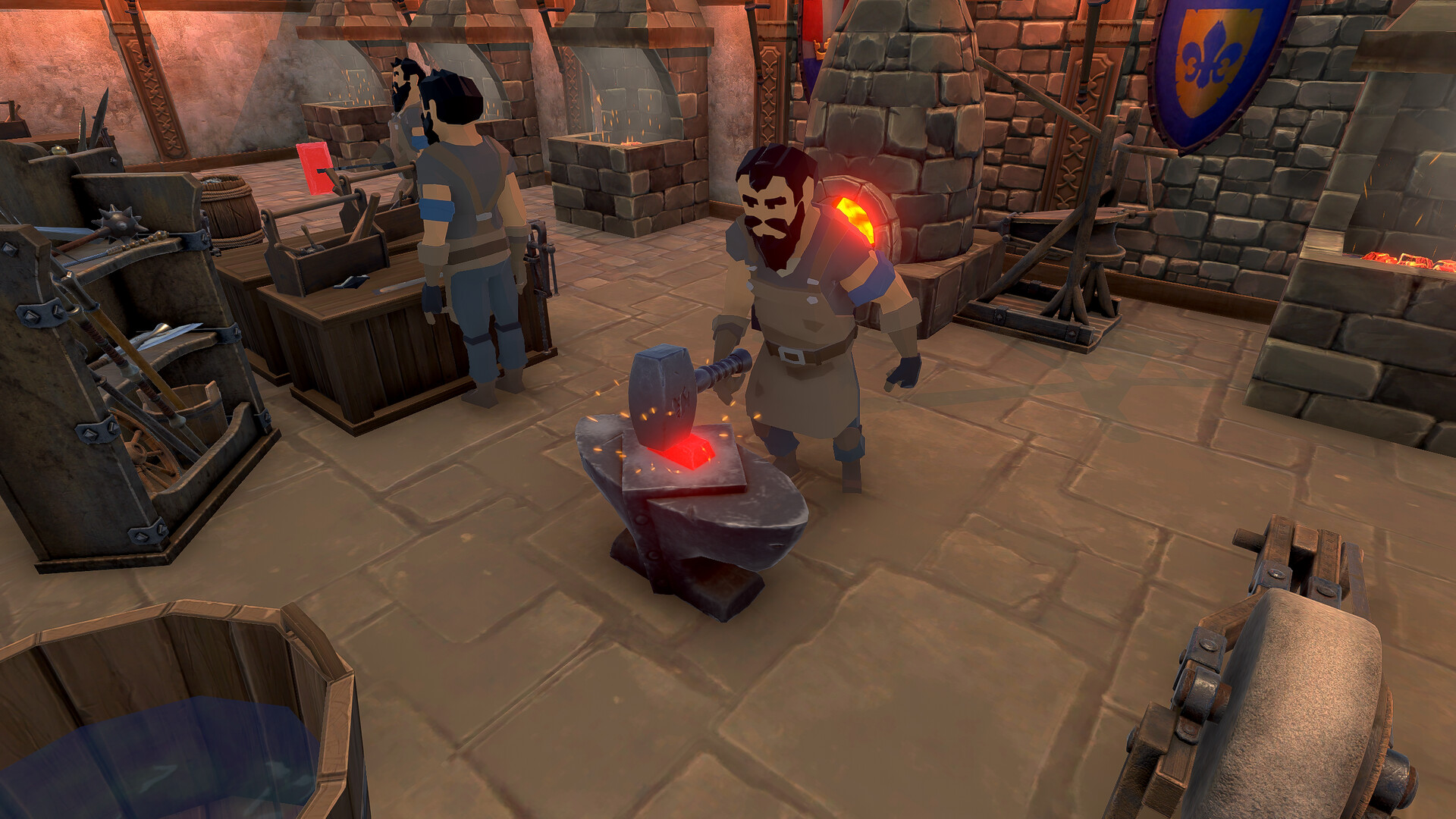
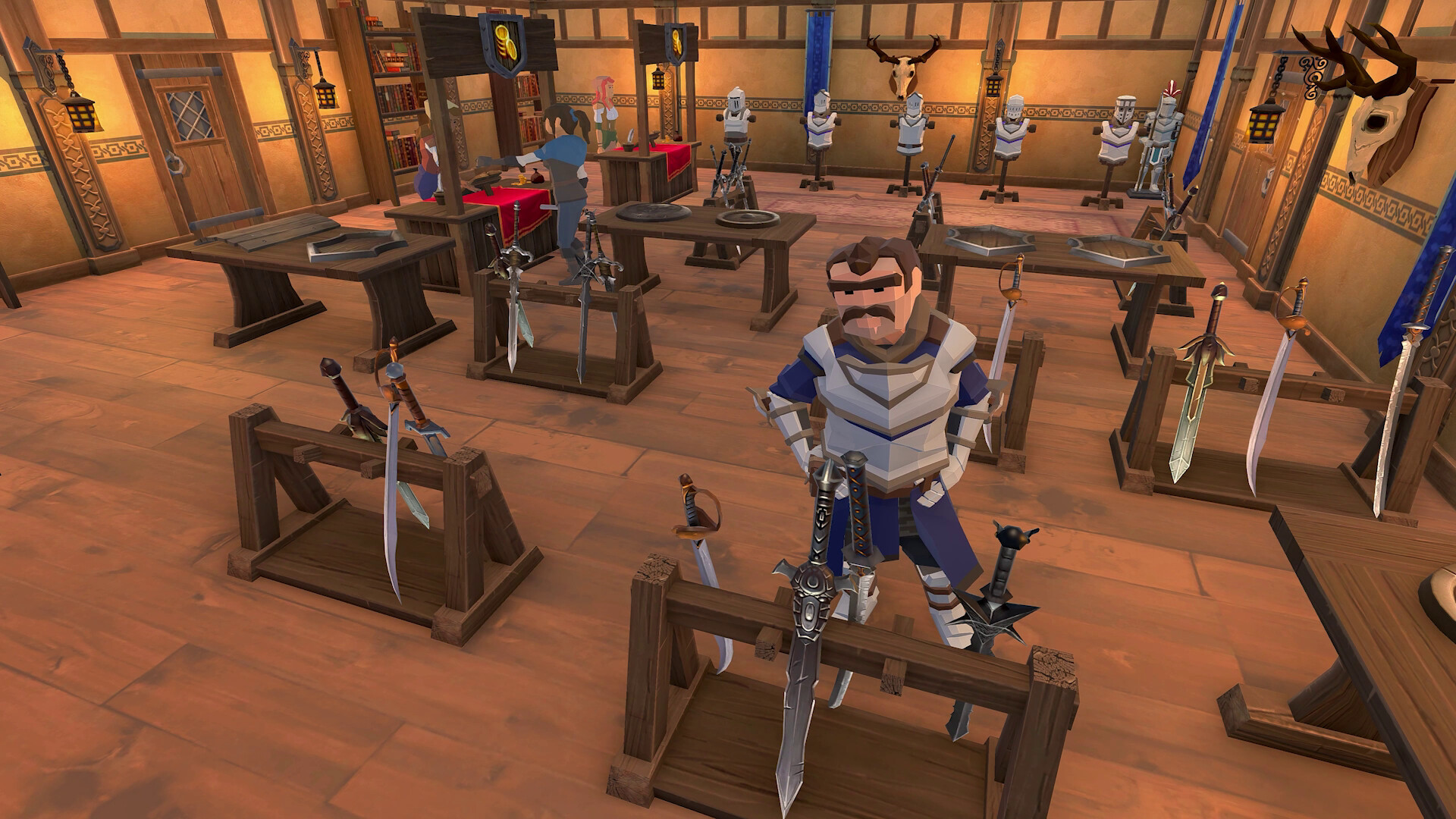
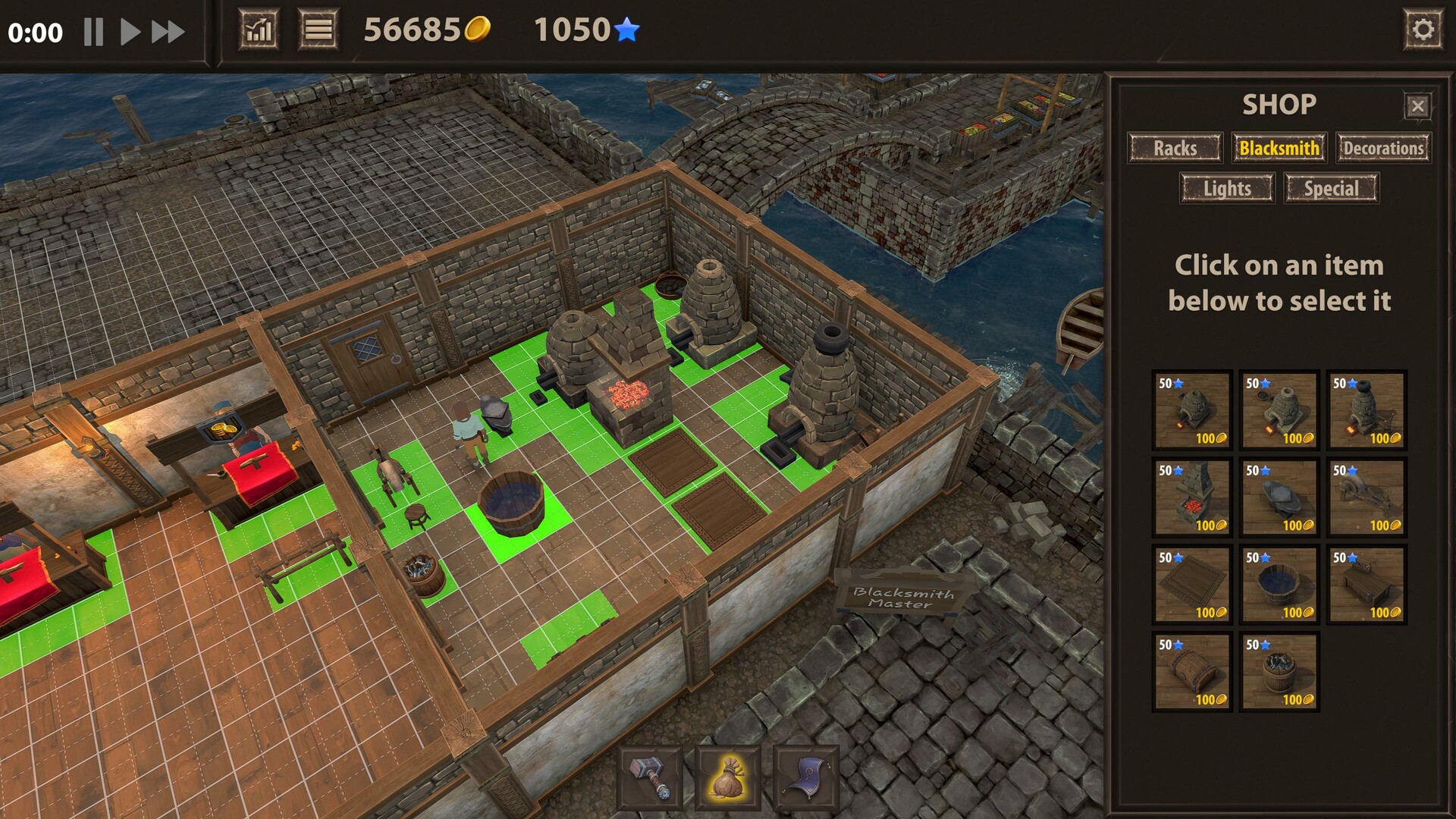

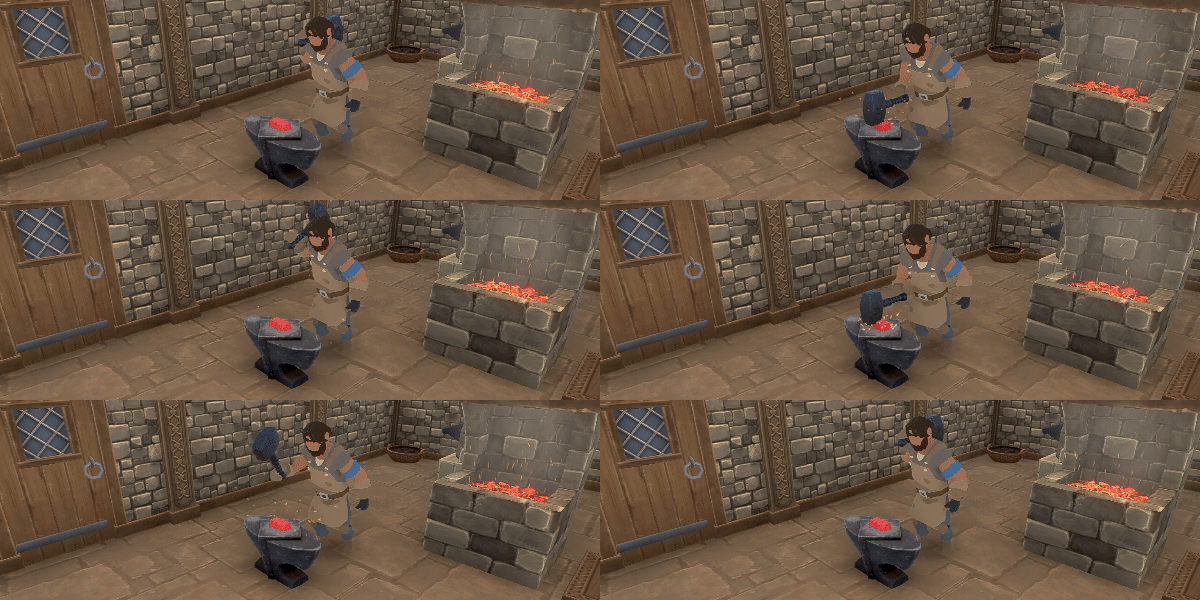

Tucked away through the winding alleys of a small medieval town lies your workshop – at first just a humble place for a humble blacksmith, but with potential for greatness. Here, you control the entire production chain - from mining the ores to smelting them into ingots, then crafting weapons, armor, tools, and jewelry to put on display and sell to customers for a profit. You will design your shop to make the best use of space, ensuring there’s enough room for the production and sale of goods alike, while adding personal touches to liven up an otherwise dreary space. As your reputation grows, so too will your operation, and it won’t be long before you become a master of your craft.
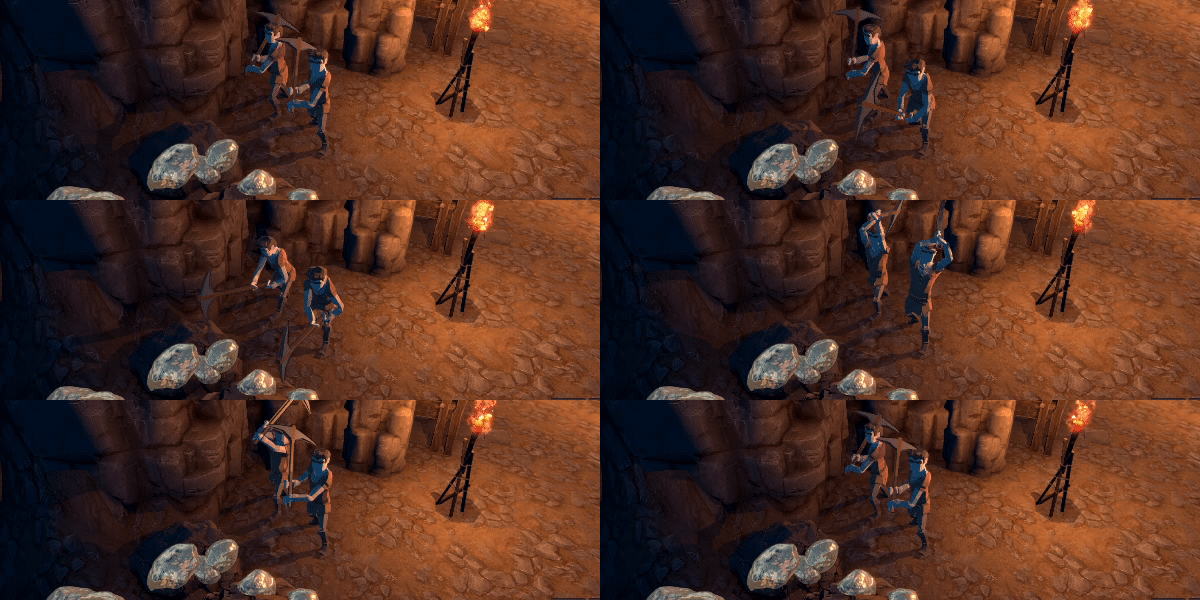

Be it a footman’s sword, a woodsman’s axe, or an inn keeper’s frying pan, everything you produce will require raw materials dug up from the earth. Hire miners, equip them with the right tools, and ensure they have everything they need to be efficient – without them, you cannot keep your business operational. Each additional miner means additional wages that need to be paid, though overworked staff are likely to get tired and inefficient. Will you opt to provide rest stations and additional staff to keep your employees satisfied regardless of cost, or will you instead keep a handful of overworked individuals to maximize your profits? After all, mining the ore is only the first step of the process, and there are many more wages to pay.
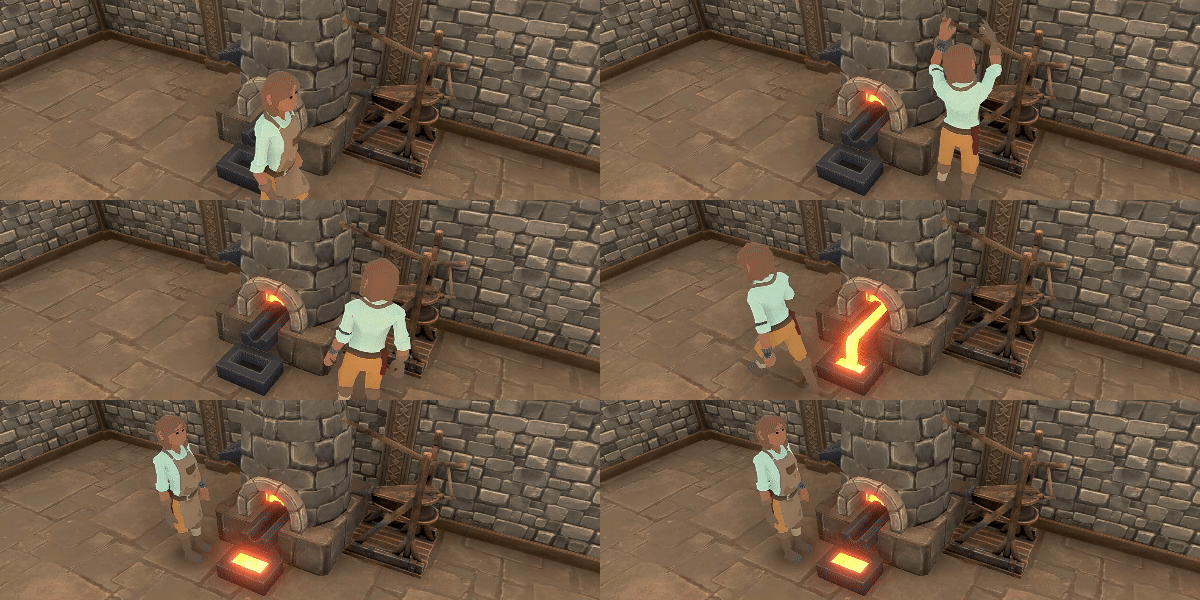

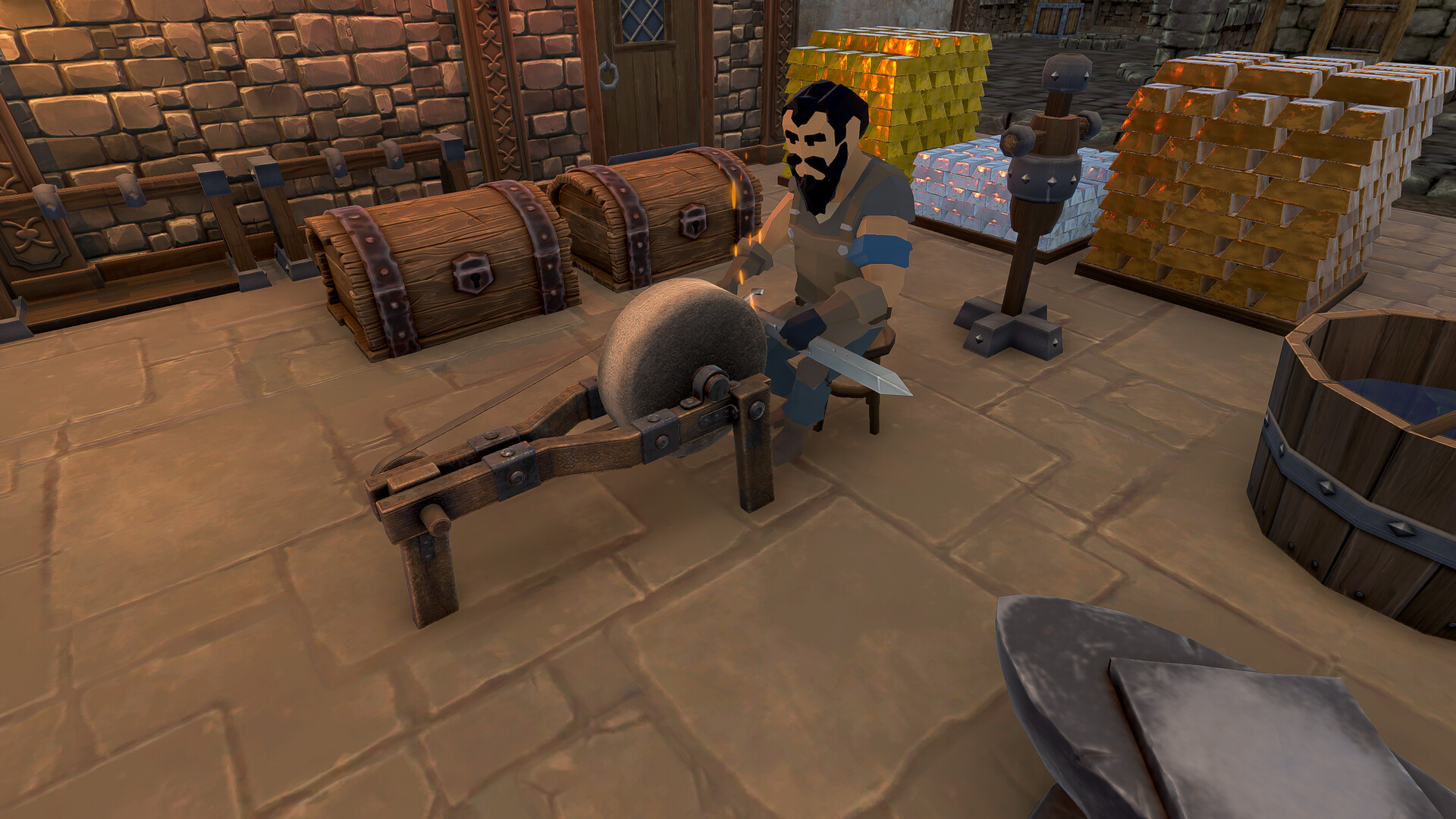
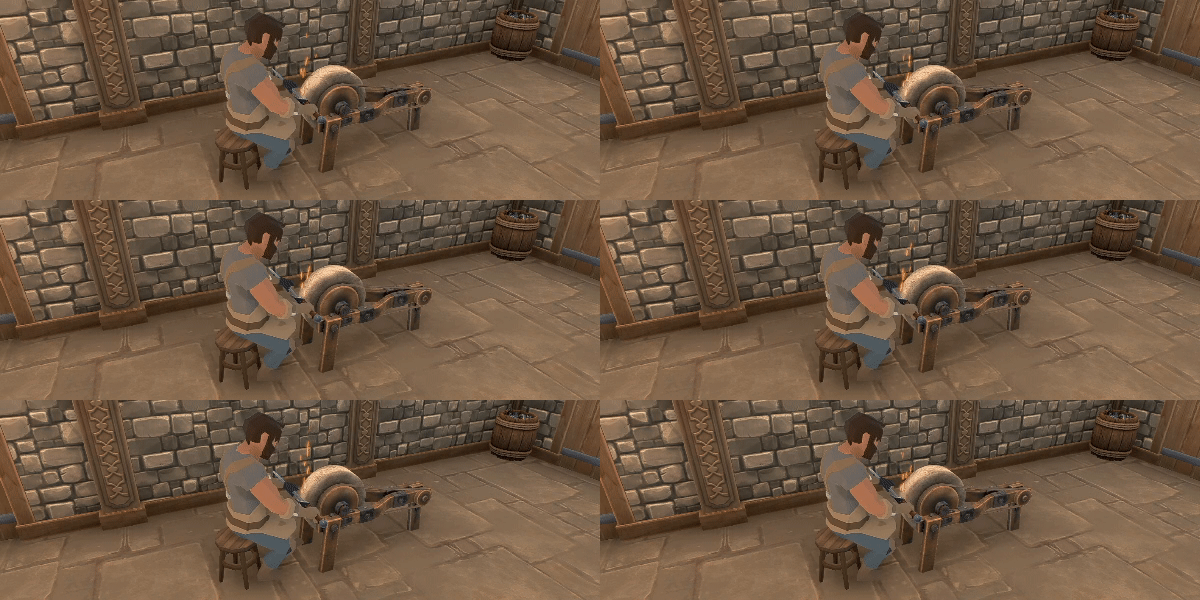
There will be many different ways to craft items in Blacksmith Master - some will require a longer process which includes heating an ingot, hammering it on an anvil, tempering it, assembling parts, and finally sharpening it on a grinding wheel. Other items will be simpler to make, requiring less effort and time, though they might sell for a smaller profit margin as a result. Your job will be to optimize your workspace as much as possible so your team of blacksmiths can work in tandem, creating goods from the simple to the highly complex, servicing customers from and around your small town. Besides weapons, shields, and armor, your crafting recipes will include other common things that medieval blacksmiths would make. This includes items like:
- Kitchen utensils - spoons, forks, pots, cauldrons and everything in between.
- Tools - from axes to hammers, take your pick!
- Jewelry - necklaces, rings, bracelets, and crowns all fetch a handsome price.
- Plus many others!

Different blacksmiths will have different skills that you need to cultivate. Some will be great at working with metal, others will be great glassblowers, and others still might be particularly proficient with gems. Crafting items of a certain category will increase a blacksmith’s skill level, enabling them to craft more complex creations, though it might come with an added cost. Will you train them as generalists, ensuring they all have support when needed, or will you seek to train famed specialists?
🕹️ Partial Controller Support
🎮 Full Controller Support
- [0 B]
Hello everyone, and welcome to a new blog post for the upcoming update! It\'s the biggest update since the early access release, so your feedback will be very welcome as always :) I\'m curious if you guys think I\'m solving the right issues, or if you want me to focus on some different area. In fact, it\'d be really great if you could leave a Steam review, letting me know what you think. I work on this game alone, and I read through your Steam reviews to know what to prioritize! \n\n
What I Wanted to Solve
[hr][/hr]- \n
- Blacksmiths were working at design tables, which were entirely unrelated to crafting items. Because of that, they had either a useless stat for crafting, or a bunch of useless stats if they were working on design (why do you need good woodworking if your only job is designing) \n
- It was way too easy to focus on one blueprint and upgrade it to legendary quality even in the early game, while everything else was common quality \n
- The planning for the design tables was very boring. You just buy a bunch of tables, place them where they don\'t bother anyone, and you hire a bunch of blacksmiths who work on generating design points. The only relevant trait was a bonus for design points.\n
Introducing Scholars
[hr][/hr] To solve these three issues, I decided to split the design into a new worker type - scholar. Now, blacksmiths can focus on crafting items, and scholars can focus on generating design points. \n\nInstead of design speed stat, blacksmiths now have a walking speed stat, which was also highly requested, and scholars have walking speed, design speed, and collaboration bonus (I\'ll come to that later). \n\n \n\n
\n\nDesign Point Scaling
[hr][/hr] This solved the first issue, now let\'s move on to the second one :) \n\nDesign points needed to upgrade a blueprint were increasing very slowly. Here is an example in the old system: \n\n| Common Uncommon | 100 |
| Uncommon Rare | 200 |
| Rare Epic | 400 |
| Epic Legendary | 800 |
| Common Uncommon | 100 |
| Uncommon Rare | 400 |
| Rare Epic | 1600 |
| Epic Legendary | 6400 |
Making Design Tables Interesting
[hr][/hr] Since thinking of layout for design tables was too boring, and I wanted to change that scaling mentioned above, I decided to add depth here. You can now unlock six different upgrades, which significantly boost the design points generated. You need to think about how to make the design space inspiring for scholars so that they work better! You can buy plants for them, add light, buy chalkboards and bookshelves, and so on. I don\'t want to spoil too much. All these things increase their productivity level, and they are not just a decoration; scholars actually use some of them, so their time is not spent exclusively at the design table. \n\n \n\nBesides that, you also need to think about how to group them. When two design tables are adjacent, scholars working there will activate their collaboration bonus, which also speeds up the design process. \n\n
Additional Fixes
[hr][/hr]- \n
- Mastery tree no longer breaks in Thai language \n
- Steam Cloud now works properly on MacOS \n
- Smelters\' pricing was rebalanced \n
Minimum Setup
- Processor: Intel Core 2 Duo E7500 (dual-core) / AMD Athlon II X2 250 (dual-core)Memory: 4 GB RAM
- Memory: 4 GB RAM
- Graphics: NVIDIA GeForce GT 630 (2 GB) / AMD Radeon HD 6670 (2 GB)
- Storage: 2 GB available space
Recommended Setup
- Processor: Intel Core i5-750 (quad-core) / AMD Phenom II X4 965 (quad-core)Memory: 4 GB RAM
- Graphics: NVIDIA GeForce GTX 650 (2 GB) / AMD Radeon HD 7750 (2 GB)
- Storage: 2 GB available space

[ 6372 ]





























[ 5843 ]


[ 1991 ]





























[ 1943 ]






























[ 986 ]






























Time left:
356099 days, 14 hours, 37 minutes

Time left:
356099 days, 14 hours, 37 minutes

Time left:
3 days, 22 hours, 37 minutes

Time left:
31 days, 22 hours, 37 minutes

Time left:
34 days, 22 hours, 37 minutes

Time left:
35 days, 22 hours, 37 minutes

Time left:
9 days, 8 hours, 37 minutes

Time left:
4 days, 16 hours, 37 minutes

Time left:
10 days, 16 hours, 37 minutes

Time left:
11 days, 16 hours, 37 minutes

Time left:
16 days, 16 hours, 37 minutes

Time left:
18 days, 16 hours, 37 minutes

Time left:
22 days, 16 hours, 37 minutes

Time left:
2 days, 5 hours, 52 minutes

Time left:
6 days, 22 hours, 38 minutes

Time left:
8 days, 21 hours, 38 minutes
Time left:
14 days, 4 hours, 48 minutes


