






Forge Humanity's Foothold in an Alien Galaxy
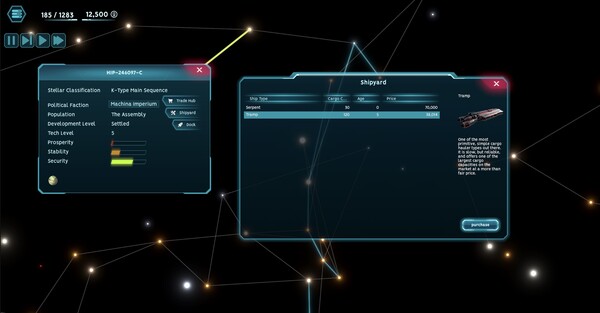
Step into the boots of a lone entrepreneur in a unique 2D top-down trading simulation where the vast, procedurally generated galaxy is your greatest challenge. You're not a conquering hero, but a vital pioneer, tasked with carving out humanity's very first economic foothold amidst ancient, powerful alien empires. This isn't about grand invasions or epic battles; it's about the quiet, strategic brilliance of trade, exploration, and survival against overwhelming odds.
A Peaceful Galaxy, Full of Peril (and Profit!)
In Trade Anchor, there's no combat. Your strength lies in your wits, your fleet of freighters, and your understanding of the market. Every decision counts: from optimizing your trade routes across vibrant nebulae and asteroid fields, to discerning the subtle needs of alien economies. You'll need to outmaneuver rivals not with weapons, but with shrewd investments and perfectly timed deliveries. The galaxy is teeming with opportunities for the sharp-eyed trader, but one misstep could mean financial ruin for your budding enterprise.
Endless Exploration, Dynamic Economies
Your journey begins with a single freighter, but your ambition will quickly expand your fleet. Thanks to procedural generation, every new game offers a fresh, uncharted frontier of star systems, unique resources, and unpredictable alien factions. Discover new trade hubs, exploit emergent demands, and adapt to markets that ebb and flow with galactic events. Will you specialize in rare minerals, exotic alien foodstuffs, or cutting-edge technology? The choice is yours, but the universe will always keep you on your toes.
Establish Your Legacy
Trade Anchor is about building something lasting. It’s about more than just making a profit; it’s about securing humanity’s future one cargo haul at a time. Expand your operations, construct new facilities, and grow your influence not through force, but through pure economic power. As you weave your network across the stars, you'll feel the weight and thrill of being the architect of a new beginning for your species.
Are you ready to write humanity's first chapter in these distant stars, with a trade manifest?

Guiding Principles
While building this game, I am following the following principles. Here they are, so you fully know what to expect:
Gameplay First
As a hobby game developer with a day job that pays the bills, I am free to skip past monetization, loot boxes, DLCs and all the other stuff that takes the fun out of gaming. My focus is purely on making a great game and an authentic, enjoyable gaming experience.
Your Opinion Matters
Early Access is all about you. Your feedback is invaluable, and I'm committed to listening. While I can't implement every single request, I promise to genuinely consider every constructive suggestion you share. Together, we'll shape the best possible game.
I'm doing Early Access to get your feedback, and I consider your feedback invaluable. I will be present in the forum to listen and consider every constructive message.
Fair & Transparent Pricing
You'll pay for the game as it is, not for promises of what it might become. The Early Access price reflects its current value, and with significant updates, there may be incremental price adjustments. This way, you always know you're getting fair value for the game at any given stage.
A new devlog has been posted to my website: https://lemuria.org/devlogs/ta-08
here is the content, with slightly worse formatting:
\nIntroduction
\nCore elements of a game deserve the most attention and thought. So for a trading game, I have of course been thinking a lot about trade and economy.\n\nIn this devlog, I will elaborate on the complete re-design of trade in Trade Anchor, the why and what it means for gameplay and players.
\n\nInterstellar Trade
\nSomething felt wrong with the goods that I have had in the demo this far. Not that they were bad by themselves, but they didn\'t give the game the \"this is the far future and FTL travel is real\" feeling.\n\nPlus there is something called the the Single Biome Planet Trope .\n\nLooking at the scale in the game, it makes no sense that things like water, biomass or raw metals are traded in interstellar FTL trade. Solar systems in the galaxy will fall fairly neatly into one of only two categories:
[olist]Systems with habitable worlds worth colonizing
[/*]Systems with no planets or no habitable planets and thus no colony
[/*][/olist]\nGiven that we so far found everything we needed to build houses, computers and space ships on just one planet, any solar system worth colonizing is pretty much certain to have all the raw materials needed for a colony. If not on the settled planets than in its asteroids or other planets.\n\nWhy would anyone import water, iron ore and similar things from another solar system?\n\nSo if I aspire to have a somewhat realistic economy, at least realistic enough to be believable and not fall apart the moment who knows the first thing about economy takes a closer look, I need to think different. There will be a lot of *local* trade within each solar system, but this is not the game that the player is playing. I need to cut that out from my mental model and focus on what people *would* import from halfway across the galaxy.
\nTypes of Scarcity
\nThere are several reasons why we on Earth buy things from halfway across the globe:
[olist]It is somewhat rare and we can\'t get it locally (either not at all or not the amounts we want)
[/*]We can\'t manufacture it locally - we are lacking the technology, industry or other requirements
[/*]We could manufacture it locally, but due to cheaper labor, raw materials, energy costs or other factors it makes no economic sense to do so - buying from abroad even with shipping is cheaper than making it ourselves.
[/*]We want it exactly because it is not from here. We value the exotic.
[/*][/olist]\nThese are the factors that I should use to build my economy. Where No. 1, 2 and 3 are somewhat related. While thinking about this, I came to one key consideration:\n\nA planet rich in raw ore doesn\'t ship the ore; it processes it into alloys or metal goods and ships those.\n\nAnd I think that makes sense. Yes, at the moment on Earth we ship nuts from country A across an ocean to country B to crack and sort them and then ship them again over an ocean to country C to sell them. But on an interstellar scale, assuming FTL travel isn\'t very cheap, if we have an abundance of something, we would build the industry to exploit it and send the output of that industry, not the raw materials.\n
\nThree Tier Trade Goods
\nWith some more design and different concepts, I have finally settled on having three types of trade goods, each with a believable reason for being traded across star systems:
\nThe Very Rare
First, very rare but useful raw materials - materials that are so rare that the majority of star systems don\'t have them at all, but which at the same time have a multitude of applications. If a material had only a few uses, the consideration from above would hold true - the few places where it can be found would become industrial centers and export finished goods built around the rare resource. But if it has countless applications, then it becomes more practical to export the raw material than to build up hundreds of different industrial lines.\n\nThis category also covers refined materials, where those are the useful form instead of the pure raw resource.
\nHigh-Tech Goods
Since all my different alien races have different tech levels, there are always goods that are useful to people who can\'t manufacture them due to lack of technology or science. A telescope is useful to even primitive people. And in the background setting of Trade Anchor, incredibly useful items like hyperdrive cores require higher tech levels to make, but are useful to all space-faring races.\n\nAnd then there are tech goods that are uncommon not because of the advanced technology they require, but due to sheer scale. Industries that are only profitable at huge scales or that require a massive supply chain. Our current real-world equivalents are the microchips industry and cloud services - if you want to play in those fields, you need to invest a couple billion (Euros or Dollars) just to participate.\n\nThis neatly complements with the first type. High-tech goods will often require rare materials, but they are found mostly on the highly industrialized core systems.\n
Exotic Goods
The final category are goods that in principle aren\'t rare, but where a specific kind has value exactly because it is from somewhere else. I will put four types into the game: Exotic food, textiles, art and flora/fauna.\n\nUnlike the above two types, these goods will have two identifiers - the type and the source. The value is in being different. These are luxury or cultural goods. If a specific fruit is popular, we will simply plant it locally - in green houses if necessary. But if it isn\'t popular to the degree where building up an entire industry to create and process it is worth it, then importing it for the few who want it exactly because it is exotic, becomes a business.\n\nThe same is true with art. Sure, if human music becomes popular with the Felindar, then some of them will start to make music in the same style and probably can make a business of it. But there will always be a market for authentic human music, made by actual humans. It might be a luxury market, but it will exist the same way oil paintings still sell even though we can print posters for a fraction of the cost.
Short Term Shortages
\nAnd then there is the other category of valuable trade: Sure, under normal circumstances, shipping water or metal ore to other star systems isn\'t profitable. Except when it is. A natural disaster, local mismanagement, any kind of causes can lead to a temporary shortage.\n\nTo keep the core mechanics simple, Trade Anchor will handle these not on the market, but as transport missions. You might already have seen that button in the \"Administration\" menu.\n\nEssentially: If system A has a shortage of X, then nearby star systems will offer you an opportunity to ship X there for a fixed profit. That\'s good for them (they get what they need) and good for you (guaranteed profit).\n\nThis is also where the late-game pieces come into place. Eventually in the game, as the name implies a bit, you will establish permanent branch offices throughout the galaxy. These will build up local connections and find you these opportunities for trade when they are below the \"big disaster we need everything we can get\" level.\n
\nImplementation
\nI\'m writing this devlog partially as a part of my design process. When writing things down and explaining them to others, they often become more clear in your own mind.\n\nSo right now, I have ripped out the old code and started implementing the new. It isn\'t yet completely done. I will start with less flavor text - so food will just be \"Food (specialtes from system A)\" and not something more inventive like \"Xyalr Root Stew\". I might add that later but it will need a whole other level of procedural generation.\n\nSo it will be a while before it is all finished. But I am very much looking forward to showing you this. It is yet another piece of the puzzle to make Trade Anchor unique and interesting.\n\n
This is a fairly substantial update, including an improved intro, many UI improvements and a lot more visibility into all the things going on in the game, like a legend for the map modes, or the display of empire cultural values.
Together with the extension to 2 years, the demo should now give you a fairly good piece of gameplay.
And it\'s an important step towards the full game release.
I am also adding a \"testing\" branch. If you want to get updates like this early, go to the properties of the game in Steam and look at \"betas\". You should be able to simply subscribe to the testing branch.
This update is going live on the testing branch first, because it still lacks a few translations that I need to add (for new texts). If you play in English anyway, everything should work. Otherwise, wait until the next update and everything will be localized.
Thank you all for trying out Trade Anchor during Steam NextFest, and for soundly beating my goal of 2000 wishlists - as I write this the count stands at 2100. Amazing.
In this update, the length of the demo has been doubled to 2 years instead of 1. In celebration of 2000 wishlists. The on-screen texts still say 1 year, because I want to wait for your feedback. If you want still more, than let\'s make it a challenge - I\'ll raise it to 3 years if we reach 3000 wishlists. :-)
There is also a new feature, the ledger, record of all transactions. No good merchant would leave home without it.
And finally there\'s a number of bugfixes and general improvements.
I read everything in the forum, so if you have any bugs, feedback or questions, see you there.
Thank you all for your interest during Next Fest. Here is one more update, including:
bugfixes
[/*]improved settings handling and loading
[/*]a few small UI improvements
[/*]alien races now have different habitability values - meaning that some aliens thrive on planets humans find hard to settle and vice versa
[/*]slightly increased availability of new freighters to buy
[/*]
Known issue in this build: The progress display is messed up during alien empires creation, but don\'t worry, it just takes a while and then continues.
I\'ve uploaded a new update for the demo including mostly bugfixes. Many of them are thanks to people reporting bugs on the forum. So if you spot something in the game that shouldn\'t be like that - don\'t hesitate to join us in the forum.
Pushed out two small updates today to address issues posted to the forum.
Posted another devlog to my website here:
https://lemuria.org/devlogs/ta-06/
This time, I\'m talking about information and diplomacy, the two key non-trading aspects of the game.
I\'ve updated the demo build with some bugfixes and improvements to the economy.
If you experience any problems, please come to the forum and let me know so I can fix it. Thanks !
Intro
Introducing: Space freighters.
In https://store.steampowered.com/app/3878170/Trade_Anchor/\"" style="color:#bb86fc;text-decoration:none;">Trade Anchor , your main characters of a kind are the space ships that you fly through the galaxy. You start with one, but you can buy additional ships as you accumulate money.
More freighters means not just more trade, but also more information. Many empires in the game make information about their markets, prices, etc. only available to those within the empire, or even only to nearby star systems. So having freighters flying through different empires can give you a huge benefit when it comes to identifying lucrative trades.
The Star Hopper
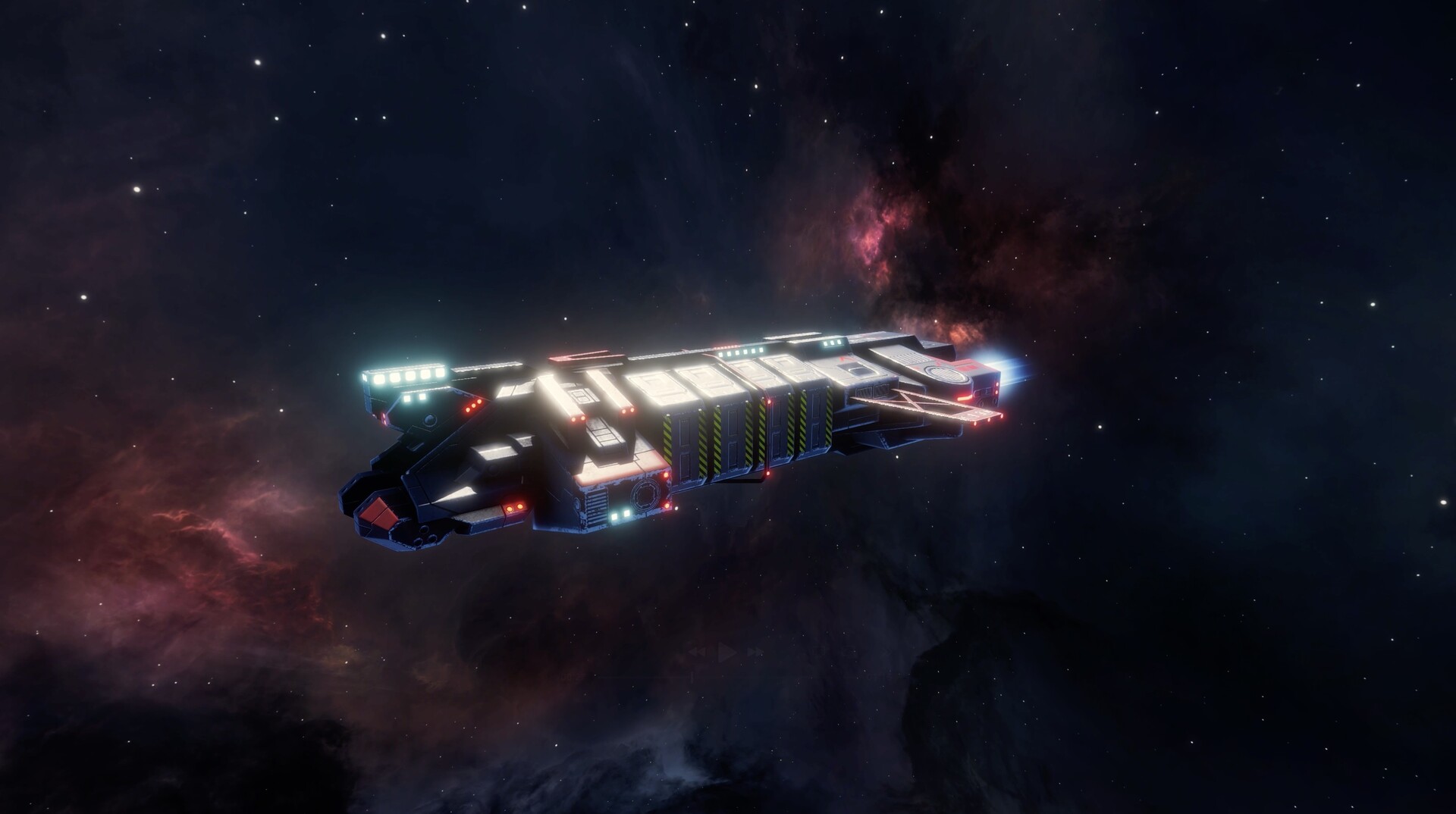
The very first ship that you start the game with is the Star Hopper which you can see in the header image.
A small, inefficient but cheap and reasonably fast cargo hauler. The Star Hopper is most beloved for being easy to maintain and can be repaired at even the most backwater outpost.
This is an excellent starter ship, though it wont get you very far once you start hauling larger loads. For that, there are other ships, which I will tell you about in future devlogs.
What is in a Space Ship ?
The more interesting question for the moment is what you can expect from your space ships.
The two main things to consider are its speed and its cargo capacity. Both of those come at a price, of course. Higher speed usually means higher travel costs. There are two ways in which a freighter costs you money: Operating and travel costs.
Operating Costs
This is a flat sum you pay every two in-game weeks. It is spent on crew salaries, life support and other systems that cost money even if the ship is just sitting in a space dock. Time is the only factor. Operating costs depend on the size of the ship - larger ships require more crew - but only a bit. For freighters, the size is mostly cargo space, so one or two additional crew members can support a much larger freighter.
Travel Costs
The second factor is the cost of travel. This is fuel, drive maintenance and other costs that occur only when the freighter is actually flying. The cost is measured per light-year. Obviously, higher speed usually means higher travel costs. But complexity of the ship and something as simple as if it is a type that was built to be cost-efficient or not, matters.
Humans, Aliens, what about that?
Glad you asked. With so many non-human alien races in the galaxy, you cannot simply buy a, say, Qyrl ship and fly around in it. While the Qyrl are a humanoid race, they are smaller than humans and have somewhat different sensory organs.
That does not mean you cant fly alien ships, on the contrary. However, it means that those alien ships you can buy are retrofitted for human use. Sometimes by humans, sometimes by the aliens themselves, or they offer it as a service included in the price.
These retrofitted ships are usually considerably more expensive, but deep within alien space you dont have much choice, and some of these ships offer speeds or efficiency that humans cant compete with. Not to mention that if you want to go into smuggling (currently a planned addition to the game, not yet implemented) flying in a ship that looks native will make things a lot easier.
Some DevLog Content
This being a devlog, I want to talk briefly about how the ships are implemented. They are actually 3D models, but the game view being a top-down map, I render these models into a sprite sheet and use those.
Depending on which direction it is flying, the respective sprite is used. For sub-45 rotations I simple take the closest sprite and rotate it a few degrees. Its more clear on some other ships, but if you look closely you can see that the sprites have different highlights and shadows. I wanted to have consistent lighting, so I needed more than one sprite. The sprite in the center is used when the ship orbits a star. In that case it is so close that the light from that sun outshines everything else, so the ship will always have the same side (the one turned to the star) illuminated and I simply rotate the sprite.
On the data side, I have defined a Scriptable Object class to hold all the information about ship types, and then a MonoBehaviour class to hold the data on individual ships (position, cargo, etc.) which references the type. Every freighter is also a game object in the scene, so having a MonoBehaviour was the logical step. Of course there is a prefab with everything set up.
I am using a data-oriented approach and have a FreighterData class in addition to the Freighter class. This class exists as variable inside the MonoBehaviour, but it allows me to easily reference the data from elsewhere, and if I ever choose to move towards DOTS and ECS, I already have a fairly good seperation of concerns.
Closing Words
Thats it for the moment, I hope I have entertained you for a few minutes with some more insights into the game. I am currently working on a very early demo. I expect it to arrive on Steam within the next 2-3 weeks. Which means in the first half of October 2025, in case you read this whenever.
The full devlog with more images is always posted on my website .
I\'ve just posted another devlog to my website.
In this devlog I explain the economy simulation that is the heart of the game.
In this second devlog, I\'m talking about the solar systems of the game, its stars and planets and how the affect gameplay:
I plan to post a number of developer logs while working on the game, and this is the very first one. The procedural generation of the playable galaxy, which can have thousands of stars. This behind-the-scenes look shows a bit of what\'s going on in the belly of the beast:
Now and always: If you wonder about specific aspects of the game, let me know and I may make that a topic for a future devlog.
Minimum Setup
- OS: Ubuntu 22/comparable or newer
- Processor: x64 with SSE2Memory: 8 GB RAM
- Memory: 8 GB RAM
- Graphics: OpenGL 3.2. Vulkan

[ 6374 ]




























[ 5872 ]


[ 1265 ]





























[ 1943 ]





























[ 986 ]































Time left:
356100 days, 11 hours, 9 minutes

Time left:
356100 days, 11 hours, 9 minutes
Time left:
4 days, 19 hours, 9 minutes

Time left:
32 days, 19 hours, 9 minutes

Time left:
35 days, 19 hours, 9 minutes

Time left:
36 days, 19 hours, 9 minutes

Time left:
10 days, 5 hours, 9 minutes

Time left:
5 days, 13 hours, 9 minutes

Time left:
11 days, 13 hours, 9 minutes

Time left:
12 days, 13 hours, 9 minutes

Time left:
17 days, 13 hours, 9 minutes

Time left:
19 days, 13 hours, 9 minutes

Time left:
23 days, 13 hours, 9 minutes

Time left:
3 days, 2 hours, 24 minutes

Time left:
7 days, 19 hours, 10 minutes

Time left:
9 days, 18 hours, 10 minutes

Time left:
15 days, 1 hours, 20 minutes


