



Praise for CGA Trek
"An absolute masterpiece... I hate to say it may be the best thing you've ever done" -- SpaceGameJunkie
"Pure fun, that's gold these days" -- fernadolv3
"wow, the dialog, this is amazing, way beyond expectations" -- best luke
Introduction
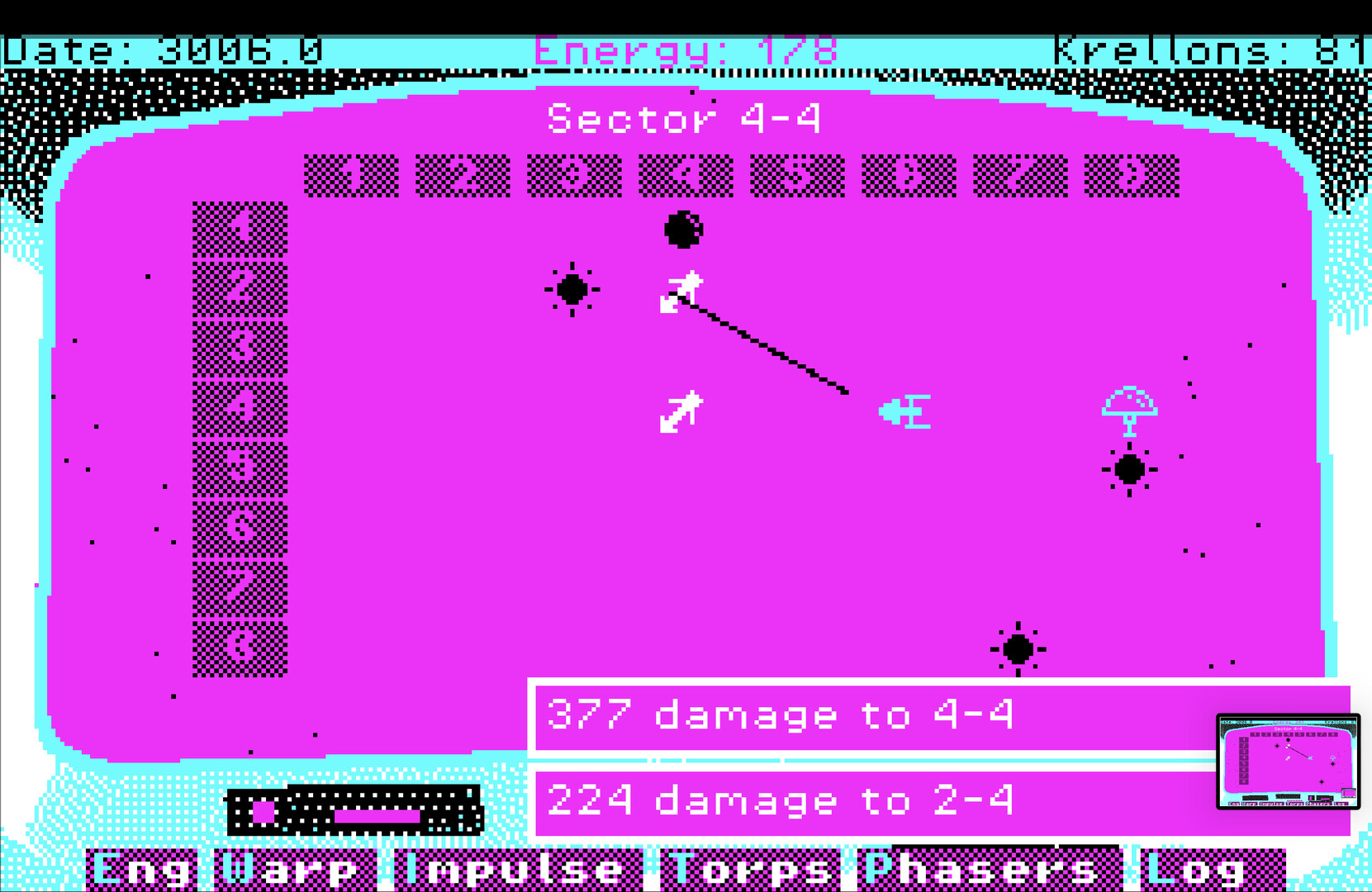
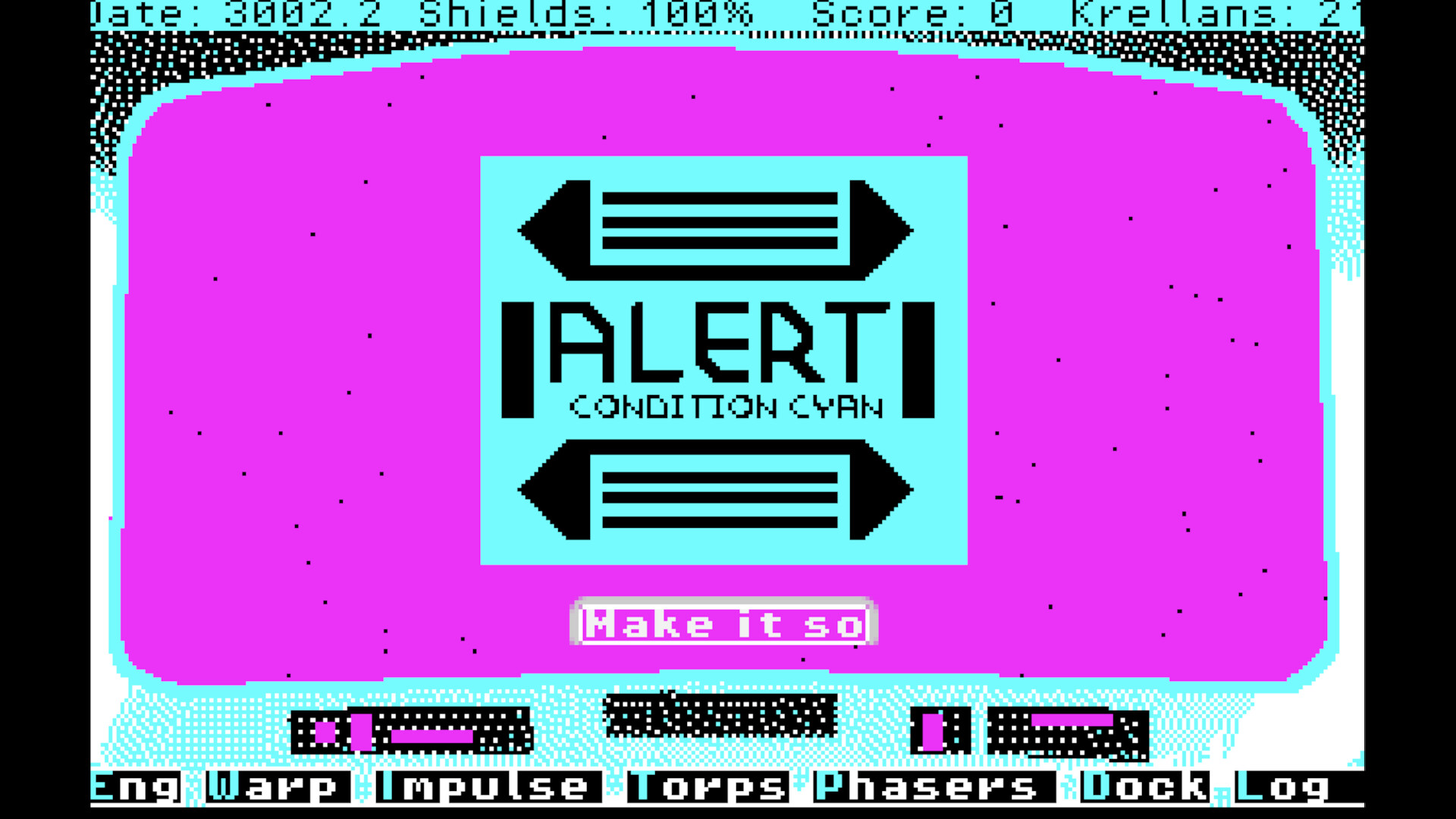
Cyan Alert! Set your eyeballs on stunned because it's time for CGA Trek!
CGA Trek is a homage to the "Trek" game (sometimes known as Star Trek, Super Star Trek, Space War or Starkill) that originated on mainframe computers in the 1970s, inspired by the innovative PC version from the late 1980s called EGA Trek. Like Riker and his transporter clone Thomas, or Tuvix, it is simultaneously a demake and remake.
It aims to be a faithful recreation of the basic gameplay but in a modern, accessible, fun package. I wanted something with strong art direction so I picked the austere and beautiful 4-colour CGA palette of early 1980s computing.
Features
Your very own starship equipped with many systems, including teletransmatporters.
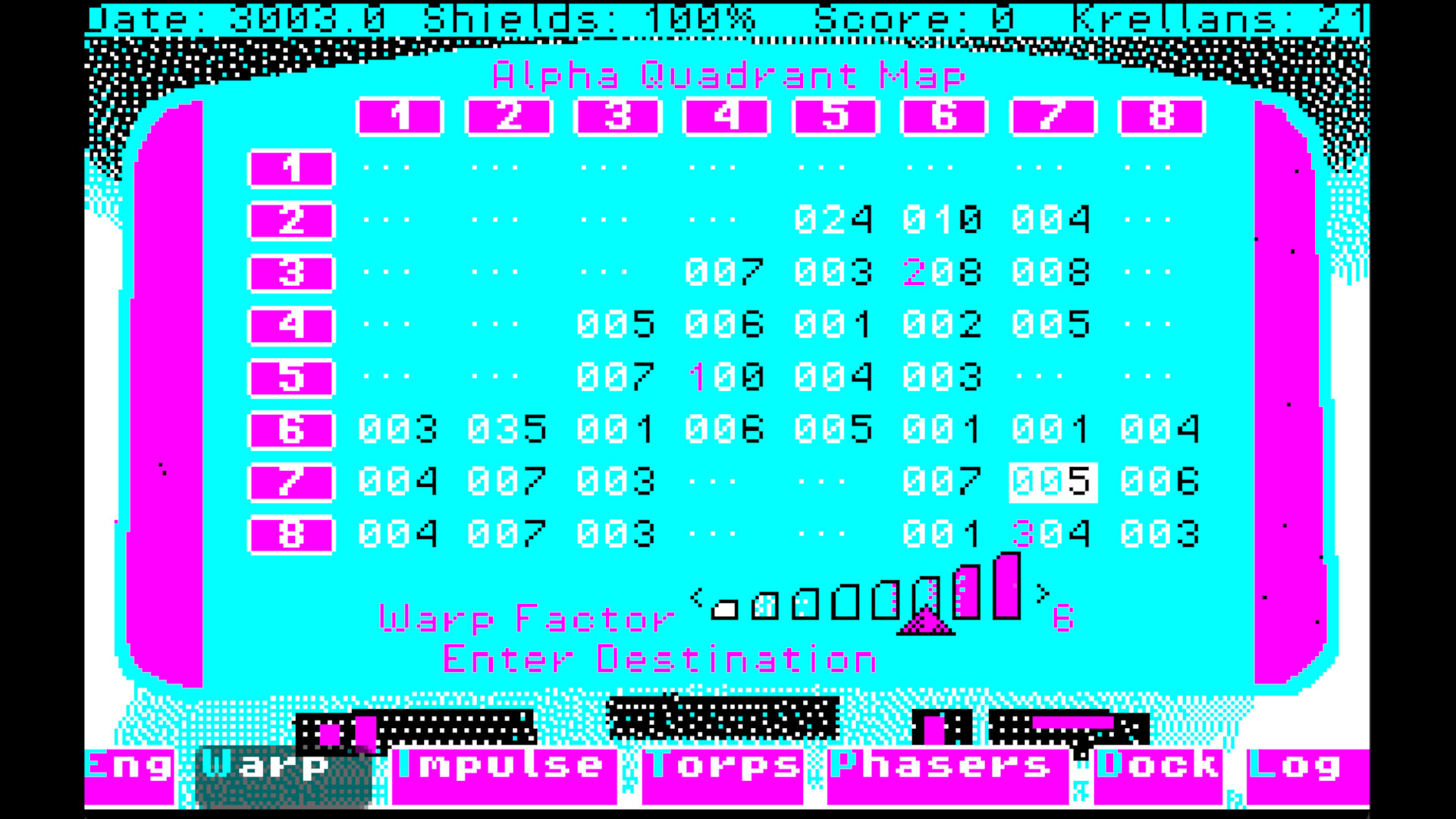
The alpha quadrant as an 8x8 grid containing 64 sectors.
Each sector is an 8x8 grid of locations
Starbases (general, research and weapon depots)
Planets (with away missions)
Enemy ships
A scenario designer with five difficulty settings
Authentic 1980s computer voice
Great 8bit music
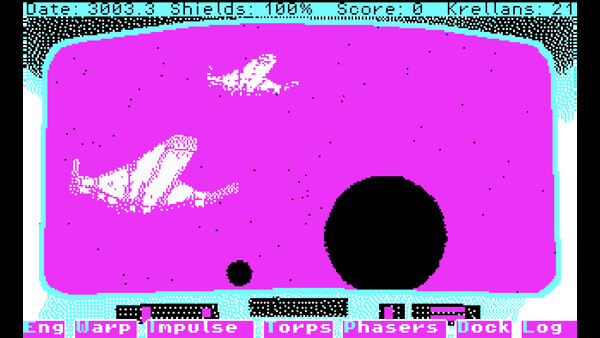
Beautiful, beautiful CGA graphics - 4 colours - using the light magenta/light cyan palette at 320x200 resolution.
A bunch of surprises for fans of the genre.
Let me know in the Steam forum if there are any accessibility tweaks I can provide to make this a great experience for you.
History
In 1971, Mike Mayfield wrote the game "Star Trek" for his local university's computer on punch tape. The game was designed to be played via a printer instead of screen.
In the 1970s, with no hard drives or floppy discs, code was often distributed in magazines and other publications. Hobbyists would read the code off paper and type it into their computer to play it.
It was this way that the code for "Star Trek" spread quickly in the computer world with variations and implementations popping up all over the place. One programmer wrote in the introduction to their version that "there have probably been more versions of this game written than any other as there is probably at least one version around for every type of computer ever made."
While the owners of the original 1960s Star Trek show gave written permission for those fan games to use elements of the TV series well into the 1970s (a decade when Star Trek was kept alive by the growing fandom) by the 1980s they appeared to have reduced this support. Jerry Pournelle (co-author of the excellent book The Mote In God's Eye - apparently also a computer nerd!) wrote in 1984 that his version of the game was renamed Star Kill after they "received a polite but insistent letter". (He also praised a variant of the game called "Star Fleet I", the sequel to which is available on Steam and is still being updated this this day).
Originally written in Sigma 7 BASIC, Trek was rewritten in many other dialects of BASIC such as HP BASIC and other languages such as FORTRAN.
It was a FORTRAN version of "Star Trek" that inspired Nels Anderson to write a version for the PC in around 1989. He upgraded the plain ASCII graphics to take advantage of new 16 colour hardware made by IBM called the Enhanced Graphics Adapter (EGA). EGA was a big upgrade over IBM's earlier Color Graphics Adapter (CGA) which effectively* did 4 colours.
The Anderson version of the game was titled "EGA Trek" and spread worldwide in the early 1990s as a great example of shareware. EGA Trek is often regarded as the best version of the genre.
While EGA was a big technological upgrade over CGA at the time, in some ways CGA has aged better. Its "weird" colour restrictions have given it a lot of personality compared to the more "normal" palettes of EGA. Additionally, the greater restrictions of CGA (fewer colours, lower resolution) can provide a lot of fun to game developers looking for a challenge. I hope you enjoy CGA Trek.
With massive apologies and much love to Nels Anderson.
* the actual colour capabilities of CGA and EGA are too complicated to fully summarise here but are popularly considered to be 4 vs 16 colours.
[img src=\"https://cdn.cloudflare.steamstatic.com/steamcommunity/public/images/clans/45829097/615c0815ed990a21a6854969c456ed32df317a3f.png\"][/img]
Hi everyone,
Welcome to the first post-release update for CGA Trek. CGA Trek is my small fast-paced version of a classic \"Trek\" game. It\'s not meant to be the definitive space game with every single feature known to humanity but I do want to add stuff that makes the game fun and interesting.
There is a bunch of new stuff but the two big items this release are:
Shields
[/*]More CGA. Yes, MORE!
[/*]
Shields
[img src=\"https://cdn.cloudflare.steamstatic.com/steamcommunity/public/images/clans/45829097/fdefe560d4d5d509b4127817518bb53f2d37b1e7.gif\"][/img]
I was happy with the first version of CGA Trek BUT every time I went into battle I was itching to raise shields. Shields are such an integral part of Star Trek (the show) and Trek games so it was my number one feature. But I don\'t want to add stuff unless it improves the game. In CGA Trek when you raise your shields it gives you a barrier around your ship that the enemies can chip away at. I think it really gives the player more options for tactics.
Starboard shields failing? Swing round and let your port shields take some damage. Or warp in with shields raised, take heavy fire, let off a volley of torpedoes and then warp the kirk out! It just adds a bit more depth to the game. I got down to 8 energy at one point (sweating).
More CGA
CGA was a type of graphics card from the early 1980s. It was commonly used to display four colours on the screen at once but it actually 16 colours. However, a programmer couldn\'t pick ANY four of the 16, it had to be from a limited number of preselected palettes. The first version of CGA Trek used the \"magenta high\" palette (magenta, cyan, white and black) but with this version you can switch to the other palettes.
I have also added contrast, brightness and saturation sliders. This gives everyone much more control of what appears on the screen without losing the essential authentic CGA feel.
Time Limits
Another big gameplay change is that on harder modes there is now a time limit. This is direct from the older Trek games and just adds a bit of spice to the gameplay. It encourages players to warp at higher speeds and spend more time in battles between visits to stations.
Changelog
change: boost number of enemies in medium, hard and difficult
[/*]change: reduce how often enemy taunts us slightly
[/*]change: reduce how often enemy sends a message before exploding
[/*]change: shrink toggle buttons to fit minimum text height
[/*]change: rebalance difficulty levels to take into account time limits and new shield system
[/*]change: smaller headings in engineering
[/*]add: add more messages from enemies
[/*]add: add saturation, brightness and contrast sliders in settings
[/*]add: add shields
[/*]add: add tutorial for shields
[/*]add: add voice over for shields up / down
[/*]add: add SFX for shields up / down
[/*]add: time limit to games
[/*]add: warp with shields up costs more energy
[/*]add: add new custom font CGA Luke 6PX bold and regular
[/*]fix: issue when entering menu from torpedo mode
[/*]fix: don\'t show subtitles if voice muted
[/*]fix: enemy energy levels now obey scenario designer setting
[/*]fix: block undo button when in the middle of phaser targeting
[/*]
If you\'ve read this far it means you are a person of refinement and discernment. Any reviews or purchases of my games go a long way to helping me make more. These sort of niche business are much more of a two way street than where a person just goes in and buys a product and goes away... your feedback and requests can get directly acted upon so your support genuinely makes it happen. Thanks!
Regards,
Luke Miller
PS. Wishlist my next game, Low Earth Orbit Adventures.
[dynamiclink href=\"https://store.steampowered.com/app/3984420/Low_Earth_Orbit_Adventures/\"][/dynamiclink]
Minimum Setup
- OS: Ubuntu 22.04+ or SteamOS
- Processor: 2+ Cores. 2+ GHzMemory: 2 GB RAM
- Memory: 2 GB RAM
- Graphics: 2 GB VRAM. Vulkan 1.0 compatible hardware
- Storage: 1 GB available space
Recommended Setup
- OS: Ubuntu 22.04+ or SteamOS
- Processor: AMD Ryzen 5 or betterMemory: 2 GB RAM
- Graphics: 4 GB VRAM. NVIDIA GTX 970 or better
- Storage: 1 GB available space

[ 6377 ]

























[ 5858 ]


[ 751 ]


























[ 2194 ]
























[ 415 ]
















Time left:
356103 days, 0 hours, 52 minutes

Time left:
356103 days, 0 hours, 52 minutes
Time left:
7 days, 8 hours, 52 minutes

Time left:
35 days, 8 hours, 52 minutes

Time left:
38 days, 8 hours, 52 minutes

Time left:
39 days, 8 hours, 52 minutes

Time left:
12 days, 18 hours, 52 minutes

Time left:
0 days, 2 hours, 52 minutes

Time left:
1 days, 2 hours, 52 minutes
Time left:
8 days, 2 hours, 52 minutes

Time left:
14 days, 2 hours, 52 minutes

Time left:
15 days, 2 hours, 52 minutes

Time left:
20 days, 2 hours, 52 minutes

Time left:
26 days, 2 hours, 52 minutes
Time left:
2 days, 12 hours, 52 minutes

Time left:
10 days, 8 hours, 53 minutes

Time left:
12 days, 7 hours, 53 minutes
Time left:
17 days, 15 hours, 3 minutes


