



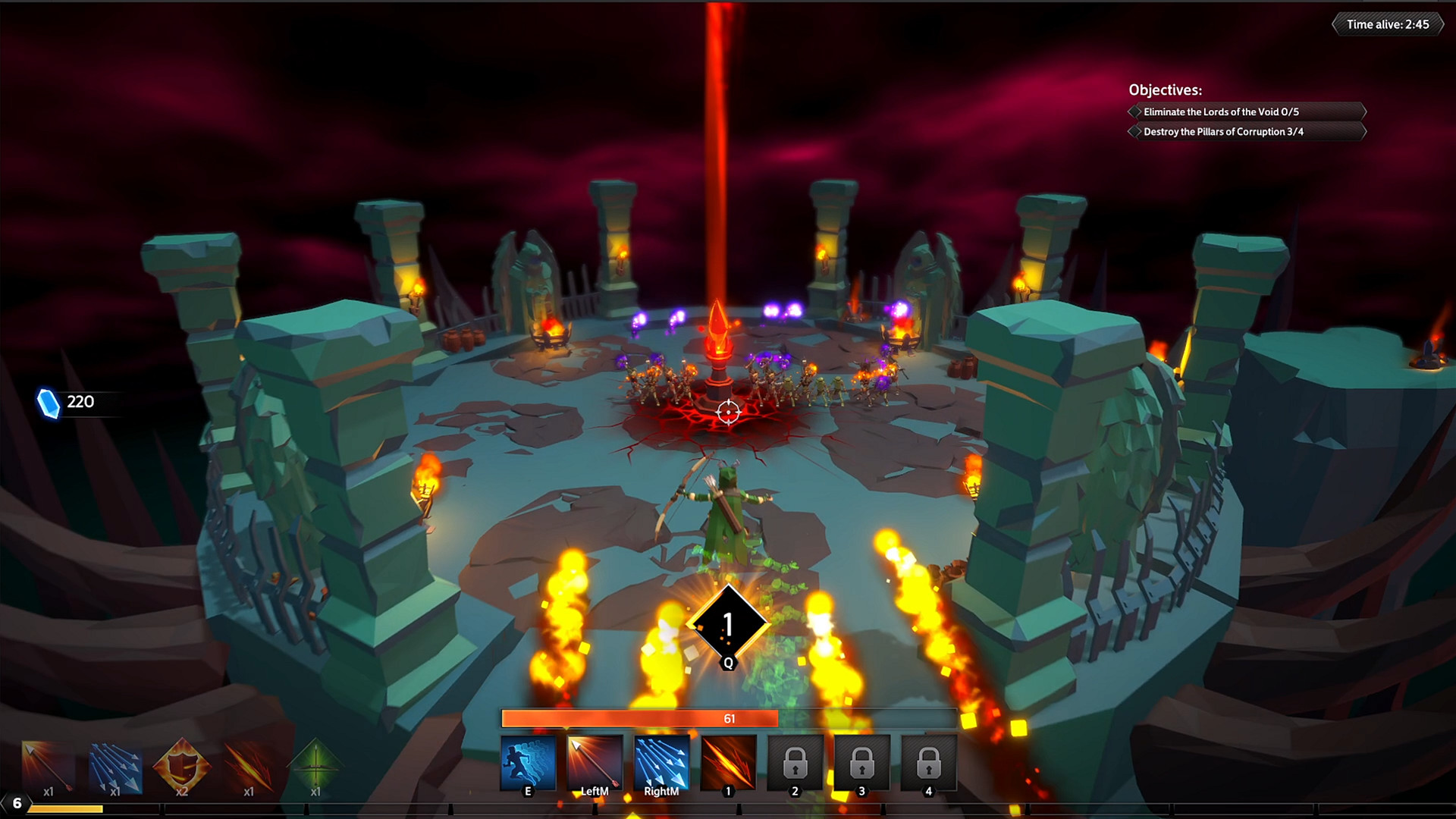
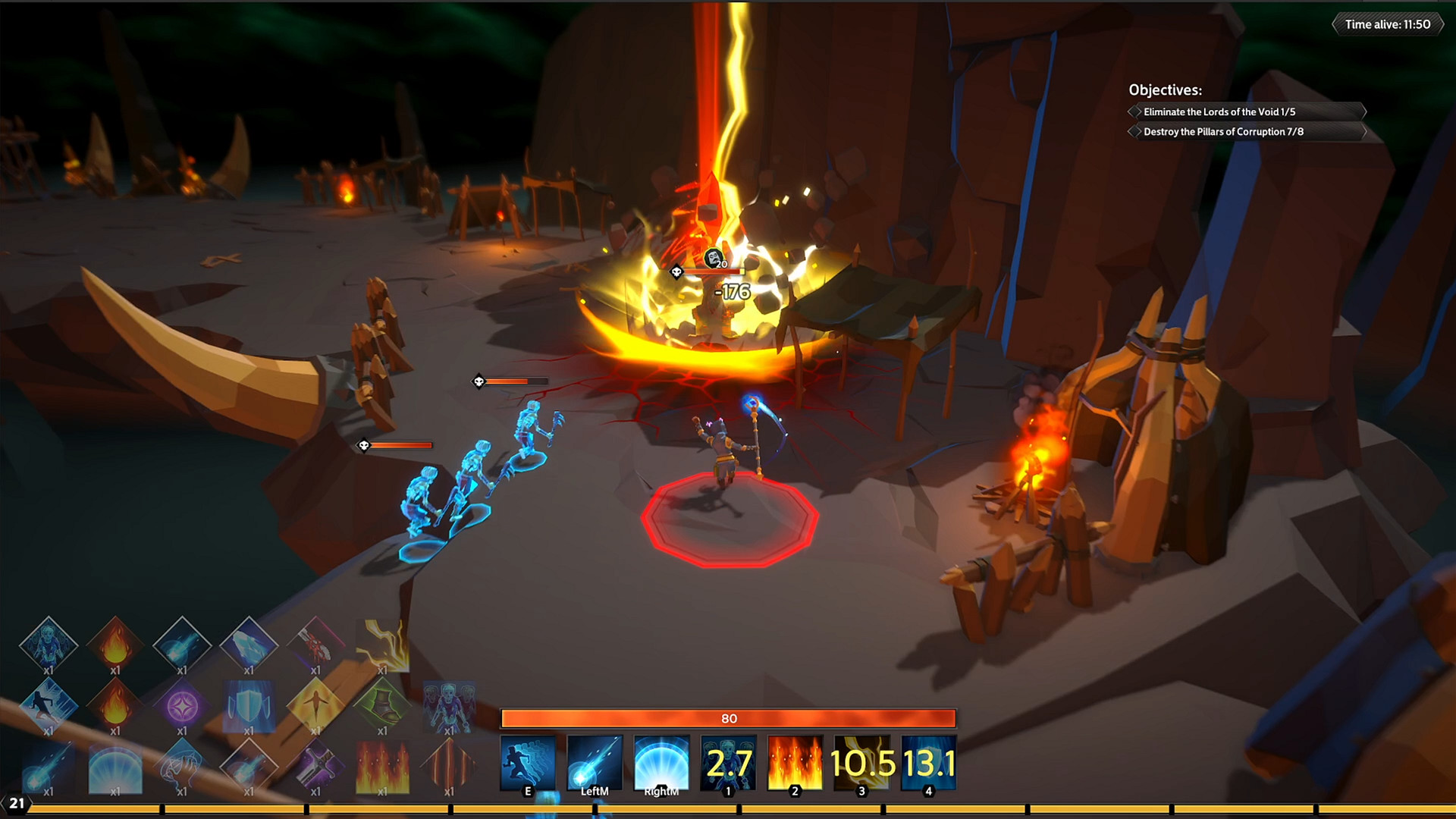


Rogue Soulstone is a fast-paced Action RPG with roguelite elements. Play as a Void Hunter and dive into a loop of exploration, combat, and evolution. Whether you hunt solo or team up with fellow Hunters, the path to the Void God is paved with choices.
MASTER THE HUNT
Each Void Hunter has a unique set of powers that can be deeply customized to fit your playstyle. Collect the Rogue Soulstones and harness their corrupt power to defeat an ancient Void God, or continue your hunt endlessly, becoming the very thing you swore to destroy.
MANAGE YOUR SANITY AS YOU FACE MONSTROUS FOES
Power comes at a price. As you explore a sea of endless synergies and power combinations, the corruption of the void will run through you and your fellow Hunters. Weight your choices strategically as you discover secret encounters in a world where every run is guaranteed to be unique.
PLAY SOLO OR CO-OP
Face the horde solo or team up with friends in seamless online co-op. Coordinate your builds to create the ultimate hunting party. Have one player draw aggro as a tank while others rain destruction from afar, or build a team of pure glass cannons and race against death.

🕹️ Partial Controller Support
🎮 Full Controller Support
Greetings, Void Hunters!
The journey has been long and arduous years have passed, hair has been lost, what little remained turned white but the time is finally here we have officially restarted development on Rogue Soulstone!!
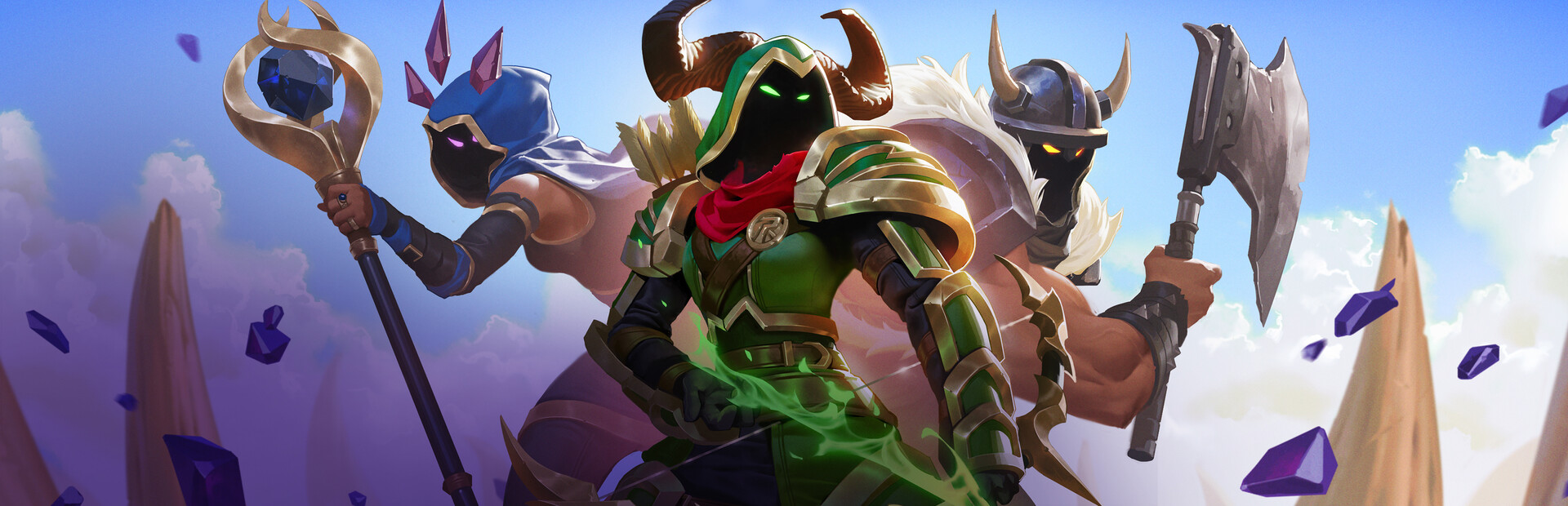
To celebrate this joyous occasion, we spoke to Victor Ferraz , a good friend of ours and amazing artist, to comission a new art piece that represents this new era for the game, and man are we excited about whats coming!

Now, to be honest, this post is more symbolic than anything! We have actually restarted development on Rogue Soulstone for a few months now but we are finally ready to talk about it!
Rogue Soulstone is going Multiplayer
First and foremost, we are officially announcing that Rogue Soulstone will support online co-op multiplayer! From the beginning, one of our main inspiration for Rogue was Risk of Rain 2. We wanted to create a fast-paced action RPG, with fluid movement, depth to explore different builds, create crazy synergies and that feeling of power (which also became a core concept of Soulstone Survivors!), but we just didn't feel confident enough to promise it would be multiplayer. We always felt like the game wouldnt be complete without it, but with our tiny team of just 2 at the time, we just couldnt commit to such a bold pursue and expect we would make it great.
However, over the last few years developing Soulstone Survivors, we not only learned a lot from you, our community, but we also built a team of 11! We became a really well oiled machine, a team that works very efficiently and well together, and that gives us the confidence to be a bit bolder, and really go for the game we wanted to create from the get go.
As we got closer and closer to the full release of Soulstone Survivors, we started thinking of the next steps for Rogue. All we had was a very simple proof of concept prototype, which is still what you can see in our screenshots and in our very very old and simple trailer in our steam page (ah, the nostalgia), and an infinite list of improvements, fixes and new systems we wanted to see in the game. Multiplayer was at the top of the list, and we knew that to make it truly great, the game had to be built around it.
 It was a really cool proof of concept but boy is it unfinished!
And that is what we decided to do. We restarted the project from scratch, and have been working for the last few months purely on our netcode. It sounds a bit boring when we talk about it but its actually pretty cool stuff! We know all too well that to turn Rogue Soulstone into a truly great game will take time, and today, we wanted to share with you our development plan, which we foresee will still take a good couple of years of development time:
Step 1 - Netcode, architecture and character movement

To begin with, we are working on the core technology of the game. For what we are trying to build, the character movement and netcode will be central parts of the gameplay experience. It defines requirements and restrictions that will shape the entire game. Even simple stuff here can drastically change the game that gets made. For example, how high a character can jump defines which ledges are reachable, how high they need to be, how spaced out they can be while how fast a character moves defines how big a level must be, how quickly projectiles will move and much much more. When you dash, do you glide a little or a lot? Do you keep momentum? How does that feel to play with? This is where we are right now, with the following work being done:
Matheus, our technical director, is heading the development of this technology, creating a low level networking library that we have control over and can support exactly the needs of our game;
[/*]The design team is blocking out prototype levels, where we can not only test the early character movement code we are developing, but also understand the dynamics of the game more in depth, how much verticality levels need, how big is too big, or too small, how fast the player should move, etc.
[/*]
As mentioned this step has been in development for a few months now, and is taking shape. It still feels a bit too early to share footage of our early tests, but we are getting there, with a networking architecture that already feels quite robust and flexible.
Step 2 - Pre-production and prototyping

Once we have the core technology in place and we are confident enough that we are not building a castle on sand, we will expand the team on Rogue Soulstone to start developing and prototyping more fine-grained gameplay mechanics. Here we will already understand what the game wants to be, what maps we are trying to create and with that knowledge we can take an informed approach. Heres what this step entails:
Elaboration and development of more specific gameplay systems (progression paths, enemy behaviours, skills, fine tuning of character control, etc);
[/*]First art pass, where we understand the breadth of the content we will need to produce and can develop an art style that not only is a good fit for the game but to our team. Here we will start prototyping and exploring art pipelines to make the work efficient, once we understand where we want to go;
[/*]Hand in hand development of sound identity for the game, to support the art and make it stand out;
[/*]Prototyping and early stages of closed testing, with select members from our community joining in and helping us to shape up the game in the right path from the beginning. Your feedback has always been key for us in Soulstone Survivors, and we want to develop Rogue Soulstone in the same manner.
[/*]
Step 3 - Full Production
This is where a game starts to really flourish, but also to harden. As the complexity of the project grows, it becomes harder and harder to change directions, which is why we will only get to this point once we are extremely confident with the plans developed in Step 2. This is where we go all hands on deck, and our entire team will focus on making the best content and systems we can for the game to offer a truly complete experience. In some ways, this is the straight forward part of the process, but also the longest, as it accounts for the meat of the game. We are talking about stuff such as:
Develop further progression and late game systems that involve more knowledge and mastery of the game;
[/*]Crank out a ton of models/textures/UIs you name it;
[/*]Produce multiple soundtracks with a clear direction, in addition to sound effects;
[/*]Hardcore frequent testing and balancing of the entire experience, polishing up systems as we go, improving usability along the way;
[/*]
Near future
While we feel this is the safest approach for our team and company, where we ramp up development on the game in stages, it also means it will still take a bit of time before we are ready to share a new demo or trailer, even though we are aiming to have those sometime next year! To bridge this gap, we will start posting a new Rogue Soulstone devlog series whenever we have cool stuff to show. It might start off with more technical stuff, but we want to keep you up to date on what is going on with the game moving forward, and you can see our first post here!
We are really excited to start working on Rogue again and hope youll come along for the ride!
Whats next for Game Smithing
Weve made a post on the https://store.steampowered.com/app/2066020/Soulstone_Survivors/"" style="color:#bb86fc;text-decoration:none;">Soulstone Survivors page discussing the plans we have for the team as whole. In short, we will continue to support Soulstone Survivors with new content, and we will also develop a new, smaller multiplayer game! This smaller game is already using the same tech that is being developed for Rogue, and is helping us to find & fix bugs and mature the netcode technology such that by the time we reach steps 2 and 3 of this plan, the netcode technology has been proven in production. The idea here is that Matheus will split his time between building the tech & character movement for Rogue as well as supporting the use of the tech in the other project (for example, by fixing bugs that may arrive related to it, etc.).

This also means that in the meantime between Soulstone Survivors and Rogue Soulstone, you will hopefully have another cool game to try out! We will share more details about it very soon(tm)!
Wouldnt it just be faster to commit fully to Rogue Soulstone?
Given the stage we are in with Rogue Soulstone, it might be counter intuitive, but it would likely take around the same time, while being a whole lot riskier in many ways. These initial stages of a game are kind of like a pregnancy stage you cant put together 9 pregnant women to create a child in one month haha, what that means here is that until there is a clear coding architecture and direction to follow, anything that gets created has a good chance of being discarded later on.
So what we are doing now, is taking these initial experimentation stages that likely would be entirely discarded for Rogue Soulstone, and using this effort to make a separate, much simpler game, with simpler being the keyword. Since it is a game with limited scope in all senses, and with a much simpler networking layer, it allows us to move quickly and test all areas of the netcode more easily.
In addition to that, being its own game, means it will see the full lifecycle of development way earlier than Rogue Soulstone would. That means that in just a few months we will go from early testing to closed testing with players, to public testing and finally release, putting the netcode to the test in a real world scenario, with real players from all around the world. We will of course do everything we can to shield ourselves from networking issues, after all we want this third game to be great as well, but it will be our first time releasing anything with multiplayer, and this game will give us that experience in a compact development period.
And in the end, the fast development of this third game, will revert to a ton of benefits for Rogue, and help us find any issues with our netcode early on, giving us time to take critical decisions earlier in the project. If all goes well, we have officially proven that our netcode works well and feel more confident to build the game on a solid foundation, and if we run into issues, we can then iron then out much earlier, ensuring that Rogue Soulstone has the best chances to be great.
So is this other game just a test project, an experiment?
Not at all! Ok, maybe just a little bit. We are actually very excited about this game as well, we have been playing it on our Friday Game Nights and every week we enjoy it more and more. It is very much its own thing, it has a very different vibe from Soulstone Survivors AND from Rogue Soulstone, it feels really fresh and so simple that almost makes us wonder how come this game doesnt exist yet?
We will talk more about it very soon and you will be able to judge it for yourself, but we really feel there is something pretty special in this game, and it just feels like the perfect fit for the moment we are in, limited scope, different, exciting, and super useful for us as a company even if all goes wrong. Its also proving to be a great test bed for co-op mechanics, and make no mistake, its a simple game but that doesnt stop us from adding quite a bit of depth to it!
Conclusions
We hope you are excited as we are for the future of Rogue Soulstone! We hope it wont be too long before we start sharing some more exciting stuff from the game, and we hope to have you for the ride as it gets developed and evolves with our devlogs!
We know a lot of people are looking forward to playing Rogue Soulstone and we are looking forward to it as well. We would love youd come with us on this journey and help us develop the game just like so many have helped us develop Soulstone Survivors.
If you have any questions, please let us know in the comments and well do our best to answer them!
Hey folks!
My name is Matheus and I am the technical director at Game Smithing. Hopefully you have read our other post about the plans we have for Rogue. If not, you can go check it out here .
It will still be a while longer until we have something like a trailer or a demo to show you, however, something weve learned while developing Soulstone Survivors is that theres a lot of value in communicating and showcasing our work with the community.
As we have resumed development on Rogue Soulstone, weve decided to start this devlog series to document the development and progress of the game. Spoiler alert, since we are currently working on the core architecture for the project, this post is quite a bit technical, but if you are curious about how the sausage is made, read on! As the game progresses we will showcase levels, characters, mechanics and so on, but for now netcode!
To start, lets take it back to the beginning.
Research
 CCTV footage of me after 2 weeks
As soon as weve decided Rogue would support a multiplayer experience, we knew we had some digging to do. Although some of our team, including myself, has had some professional experience developing multiplayer games in the past, we are far from experts. Recognizing that, I knew Id have to do some deep research into networking in general as well as game netcode.
I went on a couple of weeks of reading hundreds of pages of documents, specifications, blogs and forums, as well as watching dozens of hours of video on topics ranging from internet protocols (IP, UDP/TCP), services such as NAT (and how to traverse it), SSL/TLS and so on.
The idea here was just to get the lay of the land on general networking concepts such that I would have a strong foundation to build upon. A lot of it was purely theorical, but quite a bit was practical information that I have already put to use when developing the foundation for the game such as NAT traversal. Once I felt comfortable with the more low-level general networking concepts, I moved on to game-specific netcode.
I wanted to learn about the whole spectrum of techniques and architectures games currently use and have used in the past. Theres a lot of content out there, but surprisingly enough, a lot of it is from the late 90s to early 00s. There seems to be fewer resources on more recent games maybe the technology has stabilized by now such that we are no longer struggling with these issues as much anyway, Ive learned a lot from this process too and it has informed some of the decisions Ive made in the general architecture of the game code.
Low-level systems implementation
After a few weeks of purely researching the topic, Ive decided it was about time I wrote some code. I was quite confident that I had enough of an idea on how to go about it that I wouldnt need to throw away any code ah, how naive I was I first started by implementing the core, lower-level systems: data serialization and a reliable UDP socket layer.
Data serialization
Data serialization is a simple concept: you have a bunch of separate items you want to send to the other player (the character position, its health, its weapon) and you need to put that into a series of bytes to send over the network. One of my initial objectives was to avoid having to write specific code to serialize a particular piece of data; I wanted the system to just work. That was a mistake. The system turned out super complicated and very slow. When compared to a straight-forward way of serializing data, it was 10x slower. So I scrapped that and wrote a much simpler system that, although it requires us to write specific code to serialize something, it is so simple to use that it really isnt a big deal. We now have a pretty simple, but very efficient system (in both runtime speed and data compression) to serialize pretty much any data we want. I wrote a lot of automated tests for it too, so Im pretty confident its robust enough to use in production.
Sockets

I then moved on to writing a custom reliable UDP protocol. The UDP protocol is pretty barebones, which is what makes it a great fit for real-time multiplayer, but it doesnt have one important feature: a guarantee that your message will reach its destination. This is actually fine in most cases for example, if Im sending the player position 30 times a second, it doesnt matter if one of them gets lost because we will send a new one just a few milliseconds later. However, if you click a button on your game, and this message gets lost in the internet, the friend you are playing with might never know that the button was actually pressed. In short, there are many cases in which wed like to ensure that a message will eventually arrive, such as sending I equipped this item or I pressed this button.
Here too, my first implementation was thrown out. It was way too complicated, even though it worked. Sometimes you have to just write something to realised how much simpler it could be maybe I should rewrite this blog post too hmmm anyway. My second implementation works even better while being a whole lot simpler. We can now send messages to any known machine, reliably or unreliably, and the system will batch several messages together as long as they fit in 1 internet packet or, if the message is too large, it will split it into multiple packets, making for a very effective use of bandwidth and processing power.
Up until this point, between the entire socket and serialization code, I mustve written about 10000 lines of code and after re-evaluating and simplifying, while at the same time making it much easier to work with, we are now at about ~3100 lines of code for the 2 systems. These low-level systems are the basis in which the game will be built upon, so the time spent making sure these systems are as simple and easy to use as possible, will pay tons of dividends across the development of the full game.
Automated Tests

gameplay automated tests summed up
Automated tests are not very common in indie game development, and for good reason. Its extremely hard to write automated tests for gameplay code, and because its so difficult, its usually simpler and more effective to test the game manually. Also, you are typically playing the game every day, so youll most likely run into most issues as soon as they pop up.
Unlike gameplay code, low-level systems such as sockets or serialization libraries are much easier to write automated tests for, but much harder to test manually. These automated tests allows you to make changes and have a high degree of confidence that you didnt break anything. And believe me, the last thing you want is to have a bug in the game and wonder if the issue is with the gameplay code or the networking code; you really need to be confident that your low-level systems are working because everything is built upon them if they dont work, nothing will work.
To add insult to injury, we are talking about network code here, which by its very nature is unreliable. So if you run into something unexpected, you just wont know if it happens because a packet got lost on the internet or if its because your socket implementation is broken. Of you if you see a 5 instead of a 10 for an enemy health, you wont know if its because the damage calculation is broken or your serialization system is broken.
So, tl;dr: if you ever write a low-level system such as these, please save yourself a ton of time and write a lot of automated tests.
Servers
 simple match-making process we use daily
Networking is like sending letters if you dont know the destination address, youll never be able to communicate. This is where a match-making server comes in. A match-making server is just a computer on the internet with a pre-specified known address. The game will just ship with a list of possible addresses for these servers. This server is responsible for matching players together, which just means something like: Hey Paul, Jon lives on address XX. Hey Jon, Paul lives on address YY now Jon and Paul know each others addresses and can send letters back and forth.
I wrote a very simple match-making server in which a player can create a lobby and other players can join that lobby. The server will share the addresses of everyone in the lobby so they can communicate directly with one another.
Heres how it looks like in the game:
Gameplay Architecture
After getting two computers to talk to each other (which you would think would be easier in this day and age), it was time to come up with a gameplay architecture that would be suitable for a multiplayer game. In here, architecture just means starting a project from scratch and deciding how the code-base will look like. I have architectured quite a few games in the past, but never a multiplayer one.
Theres ways to architecture the code such that things happen automatically. The idea is that you create 1 complicated system which handles a lot of the work behind the scenes. Although that sounds amazing, it never really works out like that. What often happens is that you have to work around the system to do anything the system wasnt designed for.
This is why so many games (and software in general) end up evolving into whats known as spaghetti code. You have this massive system that orchestrates 80% of your game but the other 20%, the parts that are probably responsible for the fun stuff in the game, the stuff that is different, outside of the norm ends up being a bit hacky, stitched together around the limitations you create for yourself when you made these major decisions at the start of the project. We dont want to go down that rabbit hole.
Weve chosen flexibility. We believe the challenges this game will bring are quite complex and we want to have the flexibility to tackle these challenges in any way we want. The trade-off we are making is having to pay a higher upfront cost whenever we need to develop a new system. This is not particularly great for prototyping, but in the long run we believe it will pay off.
System Example: Networked Object creation
Let me give you an example to make things concrete:
We arent going to have a system that automatically creates networked objects. In many networking solutions, particularly the ones used in Unity games, if you create an object on your local computer (say you throw an item on the ground), the networking system will automatically detect this new object, and inform all of the players that this object was created behind the curtains, so that they will also create a copy of this object in the same position as you did in your machine. It just works magically, from the point of view of your game code, you just believe it is there and that it will work and trust the system with your life.
In our system, however, the code that creates the object would also have to purposely send a message such as I just created this object to all other players. If there are multiple places in which objects are created, all of those places would need to send that message as well.
This may sound a bit dumb and a lot harder to develop, after all, who doesnt like MAGIC? But in reality what this gives us is full control of what is happening in the game and although it is more code, its not particularly complicated code, so it doesnt end up costing much. So we pay a small premium when developing a new system, but we gain complete control of what and how the system will work, which will be invaluable when creating sophisticated systems that are particularly difficult to develop.
Basically: it will be easier to develop complicated systems, but harder to develop simpler systems. Thats a trade-off we are willing to make.
Test Scenario
Heres how the game looked like a couple of weeks ago:
this footage was captured with a 300ms ping
This is obviously very crude and early, designed purely to test out the concepts explained above, such as how we create projectiles and sync them over the network, how do we keep player position consistent across multiple computers, how can we make the movement smooth and not janky due to network variability, etc, so it might look ugly, but it proves the foundations upon which we can start to build the real game.
Conclusions
Thats it for our first devlog entry. I tried my best to keep it as simple as possible, but if you folks want to get into the weeds of the technical details (or the opposite), do let us know in the comments! For now we dont have a specific timeline for these devlogs, as work in these initial stages varies a lot, where one week there is something super cool to show and then you go a couple of months working purely on core systems, but if there is anything you would like to see do let us know as well!
If you have any questions or comments, please post them below. Ill try my best to reply to them here or in a future devlog. Ive anticipated a question which I can answer now:
Why not use a off-the-shelf library?
There are some great off-the-shelf solutions out there, so to understand our decision we need to talk about the concept of allowable tolerances. It is pretty simple: how precise do you need to be when doing something? The stopwatch used to track how long your egg has been boiling on the stove is a lot less precise than the stopwatch used to track a potential world record at the Olympics. Even though they both track time, they are not interchangeable.
For a simpler project, using an off-the-shelf solution is more than adequate because you dont need much control over how things are done. As long as it gets done, its all good. When you have a sophisticated project with a lot of moving pieces and you want everything to feel just right, you need control. And when you need control, an off-the-shelf solution is hardly the best option, for a few reasons:
Lack of control
Because its a generic tool that was not build in the context of your game, your game has to adapt to its context. Theres usually the right way to use it and doing it any other way is like swimming against the tide. Even the ones that give you control, if you want to exercise that control, youll end up doing everything yourself after all, thats why you needed the control in the first place. But now you are doing it yourself, but within their framework, which may or may not be conducive to what you are trying to build, so you get the worse of both worlds.
Workflow
Game development is very difficult and iteration is key. During the development of Soulstone Survivors, we created dozens of tools to help us develop the game; anything from automatically downloading localization files, to build systems, to scene management, shader conversions and many more.
Using an off-the-shelf solution means you are stuck with their tooling. It may be that you need to press a button every time you change some code so the system knows about your changes, or it may be that if this process is automatic, it takes too long such that now you have to wait 10 seconds longer every time you change some code.
We could build tools on top of the framework to alleviate the problem, but that is unlikely to result in something optimal. And we are aiming for optimal here.
Cost
I dont necessarily mean financial cost, although thats also a factor in these decisions. I mean the ongoing cost of using and developing atop of a third-party framework vs building our own framework.
This game will likely take a couple of years to develop and, hopefully, will be maintained for many more years after that. If it takes us a couple of months of 1 person to build a networking solution, thats a small fraction of the development time. So using an off-the-shelf tool would save us a fraction of the development time, but would be an ongoing cost during development for however many years the game is still alive. The cost here comes in the form of working around the framework whenever we need to do something that was not particularly suitable for it, or having to use its sub-optimal tooling as mentioned above, or the financial cost associated with it. Its all friction points that wed like to eliminate for a long and large project such Rogue.
Expertise
If we can, we plan to continue making games for the rest of our lives, and we want co-op and multiplayer to be an important part of our future projects, and building our own tech will allow us to build expertise in those areas. If it costs us a few months to build that expertise now, its a price we are willing to pay, as it will pay dividends for as long as the company is still going, which will hopefully will be many decades.
Given these factors, we are extremely confident in our decision to build our own network tech.
We've just released update v0.5.017 and with it, a ton of improvements and changes that should make the game much smoother, with some highly requested features, such as Quick Cast, improved aiming, more options, loads of fixes and more! If you'd like to learn more, do join us in Discord (https://discord.gg/5RcXb8attT ), we are always online and discussing with the community what changes to tackle next. Below is the full list of changes:
General:
- Quick cast: now while you hold down the button of a skill, you aim the skill, when you release the button, you cast the skill. You can turn this option off to go back to the previous casting method, where you have to press your Main Skill button to cast aimed skills;
- Permanent Crosshair: You can now turn on and off the presence of the crosshair permanently. It will always be shown when aiming skills;
- Auto Level Up: If this option is turned on, the "Level Up" interface where you select a new power-up will open automatically as soon as you level up. You still get to select the power-up you want.
- Improved Projectile aiming code so it is more reliable in all distances;
- Made it so Arcane Weaver basic staff prioritises enemies rather than scenery;
- Added option for Damage numbers to be hidden;
- Weather forecast predicts meteor showers;
- Fixed issue where certain Buffs and Debuffs would be applied on dead entities;
- Fixed issue of crosshair showing during Pause and Ending screen menus;
- Fixed issue where Tooltip in the options menu would stay if it was closed pressing esc;
- Fixed weapon description overlaying on top of character description;
- Fixed soulstone collider not being indicative of its size;
- Fixed damage numbers appearing when you look in the opposite direction;
- Fixed skills receiving useless buffs, such as Void receiving extra shadow damage, also fixed the requirements of power ups based on this change;
- Summoned allies damage done will now trigger overhead text damage, and count towards the stats at the end of the match;
- Fixed Bloodlust tooltip which was showing the wrong duration and intensity;
Balance changes:
- Skill cooldown's now cannot be smaller than 0.2 seconds;
- Buff skills are no longer considered Physical and Instant;
- Bloodlust buff is now reduced from 30% speed to 25% speed;
- Experience required to level up considerably increased at earlier levels, but reduced at higher levels;
- Slash cooldown increased from 0.35 to 0.45;
- Heavy Strike bleed damage reduced from 50 to 20;
- Heavy Strike bleed stacks per attack reduced from 2 to 1;
- Arcane Missiles damage increased from 20 to 40;
- Arcane Missiles firing rate reduced from 0.3 to 0.4;
- Arcane Explosion knockback force increased;
- Minimum skill cooldown reduced from 0.2 to 0.15;
- Summon Skeleton minions will now be able to go further away from you;
- Brutal Strikes now has a 50% chance of applying Bleed on critical hits, down from 100%;
- Spontaneous Combustion chance increased from 10% to 15% and now also works on critical hits;
- Touch of Ice chance increased from 10% to 15% and now also works on critical hits;
- Fateful Strikes chance increased from 10% to 15% and now also works on critical hits;
- Decimating Strikes chance increased from 10% to 15% and now also works on critical hits;
- Poisonous Blood now has a 50% chance of applying Poison when you apply Bleeds, down from 100%;
- Disintegration now has a 50% chance of applying Light when you apply Burn, down from 100%;
- Hypothermia now has a 50% chance of applying Fragility when you apply Chill, down from 100%;
- Impending Doom now has a 50% chance of applying Confusion when you apply Doom, down from 100%;
- Gangrene now has a 50% chance of applying Bleed when you apply Fragility, down from 100%;
- Debilitating Plague now has a 50% chance of applying Chill when you apply Poison, down from 100%;
- Increased Fire Shield initial damage from 10 to 40;
- Increased all "Area of Effect" power-ups for specific skills from 20% to 30%;
- Reduced all "Cooldown Reduction" power-ups for specific skills from 20% to 15%;
- Increased all "Damage by Type" power-ups from 15% to 20%;
- Increased all "Area of Effect by Type" power-ups from 10% to 20%;
- Agile movement speed increased from 15% to 20%;
- Behemoth max health increased from 20 to 30;
- Immovable Mass increased from 50 to 70;
- Indomitable block chance increased from 5% to 10%;
- Lethality critical chance increased from 10% to 15%;
- Merciless critical potency increased from 20% to 30%;
- Resilient damage reduction increased from 10% to 15%;
- Removed all pushback related power ups from the game;
We hope you enjoy the update, and we would love to know what you are thinking about the game and the changes!
Best wishes
The dev team
The major update v0.5.014 is now out and it is by far our biggest update ever! With tons of new skills, dozens of new power-ups, the skill tree fully available in the demo and so many more changes, the game experience has been completely changed! Download the demo and give it a go and let us know what you think!
Here is the full list of changes:
Key changes:
- New System - Skill Tree: Enhance all your characters with powerful passive skills that will considerably increase your chances of success;
- Rerolls and Power Up Banish are now available through the Skill Tree;
- Game Objectives: Gameplay now easier to understand for new players, and tracking your progress so you know how far along you are from completing a map;
- Map Selection & New Scenario - The Hallowed Core;
- Improved attack telegraphing, so Boss battles are even more about player skill;
- You can now collect the Soulstones of powerful defeated foes (bosses), which can be used to unlock the most powerful skills in the skill tree;
New spells:
- Summon Skeleton: Summons 3 skeletons to fight for you, up to a maximum of 12 simultaneous skeletons;
- Thunder Clap: Powerful melee strike that hits the ground, stunning and applying dazed to all enemies hit, plus heavy area damage;
- Subdue: Fast melee strike that applies fragility and deals more damage based on the number of bleeds on the target;
- Thrust: Melee strike that hits in a long and narrow area in front of the player, applying bleeds and causing heavy damage;
- Bloodlust: Empower you and all your nearby allies, increasing movement speed by 30% and granting 30% of cooldown reduction;
- Might: Empower you and all your nearby allies, increasing all damage caused by 30%;
- Shield Wall: Empower you and all your nearby allies, reducing damage taken by 90% for a short duration;
- Piercing Shout: Weakens all nearby enemies, increasing the damage they receive by 50%;
- Intimidating Shout: Weakens all nearby enemies, reducing the damage they cause by 50%;
- Smite reworked: Deals heavy damage to enemies in the target area after 3 seconds, also healing allies for a small amount. No longer affected by negative effects;
- Chaos Bomb reworked: Now deals a random amount of damage between 1 and 600, and is no longer affected by negative effects;
- Added tons of new Power-ups that can enhance specific skills, or skill types such as Fire, Ice, Projectiles, etc;
Balance changes:
General:
- Arcane Weaver cooldown reduction reduced from 20% to 10%;
- Arcane Weaver's Ignis Staff cooldown reduction effect removed and replaced with 15% movement speed bonus;
- Reduced delay between Pillar spawns when a wave ends;
- Synergy effects will now chain without limitations;
- Minimum damage should now be 1, even if you have 100% damage reduction;
- Poison Bomb now applies additional poison charges every 1 second, instead of every 0.5 seconds;
- Poison Bomb extra charge damage reduced from 50 to 30;
- Poison Bomb cooldown increased from 6 to 15 seconds;
- Festering Strike damage increased from 50 to 100, now applies a powerful poison stack causing 200 damage over 25 seconds, but it no longer refreshes the duration of poison effects on the targets;
- Fire Pillar no longer refreshes Burn durations on the target;
- Glacier damage increased from 150 to 180;
- Meteor initial damage increased from 50 to 80;
- Fiery Missiles burn damage reduced from 40 to 20;
- Fire Bolt no longer pushes you back, initial damage increased from 60 to 80;
- Ground Slam damage increased from 50 to 100;
- Lightning Bolt damage increased from 120 to 200;
- Poison Bolt damage reduced from 400 to 250;
- Thunderstrike cooldown reduced from 16 to 12 seconds;
- Uppercut damage increased from 10 to 120;
- Fire Shield damage increased from 20 to 50 per projectile;
- Explosive Reflexes power up removed from the game, as it was not very useful and could lure players to make the wrong choices;
- The following power ups are now considered Rare, up from common: Brutal Strikes. Poison Blood, Disintegration, Hypothermia, Impeding Doom, Gangrene and Debilitating Plague;
- Immovable power up now increases mass by 50, up from 20;
- Nimble power up is now Rare, down from Epic;
- Resilient power up is now Uncommon, down from Rare;
- Wise power up is now Uncommon, up from Common;
Alexi, the Plaguebearer:
- Starting from Tier 3, Alexi has a new spell;
- All of Alexi's attacks now are telegraphed, showing the area damage that will be caused;
- Considerably increased the number of creeps spawned during the fight;
- Fixed an issue where the Poison Bomb attack could damage multiple times per projectile, resulting in instant death;
Other changes:
- Reworked "Replace Skill" panel, now it is simpler to understand;
- Added skill tooltips to your Skill Bar and Replace Skill panel, making it easier to know precisely what a skill does. Tooltips also calculate the adjusted values for a skill based on your attributes and modifiers;
- Power Ups and skills can now be seen in the Ending Screen;
- Added Elite Enemies in the first stage of a match;
- Skills now have types, such as Fire, Ice, Projectile, and may be enhanced with power ups based on those types;
- Power-ups will only appear when they are relevant to the player. For example, a power up that increases Fire Skill damage, will only appear if you have Fire skills in your deck;
- Some power-ups can only be picked a certain number of times;
- Units will no longer continue spawning after the player dies (and remains in the end game screen);
- Boss health bars will now accumulate if more than one Boss is alive at any time;
- Tons of new visuals all across the game between interfaces, VFXs, models, etc;
- Tons of bug fixes in all areas of the game;

Another week has passed and another update is here! Version v0.4.009 is by far the largest update yet, and brings with it tons of quality of life improvements and more importantly: Weapon Crafting!
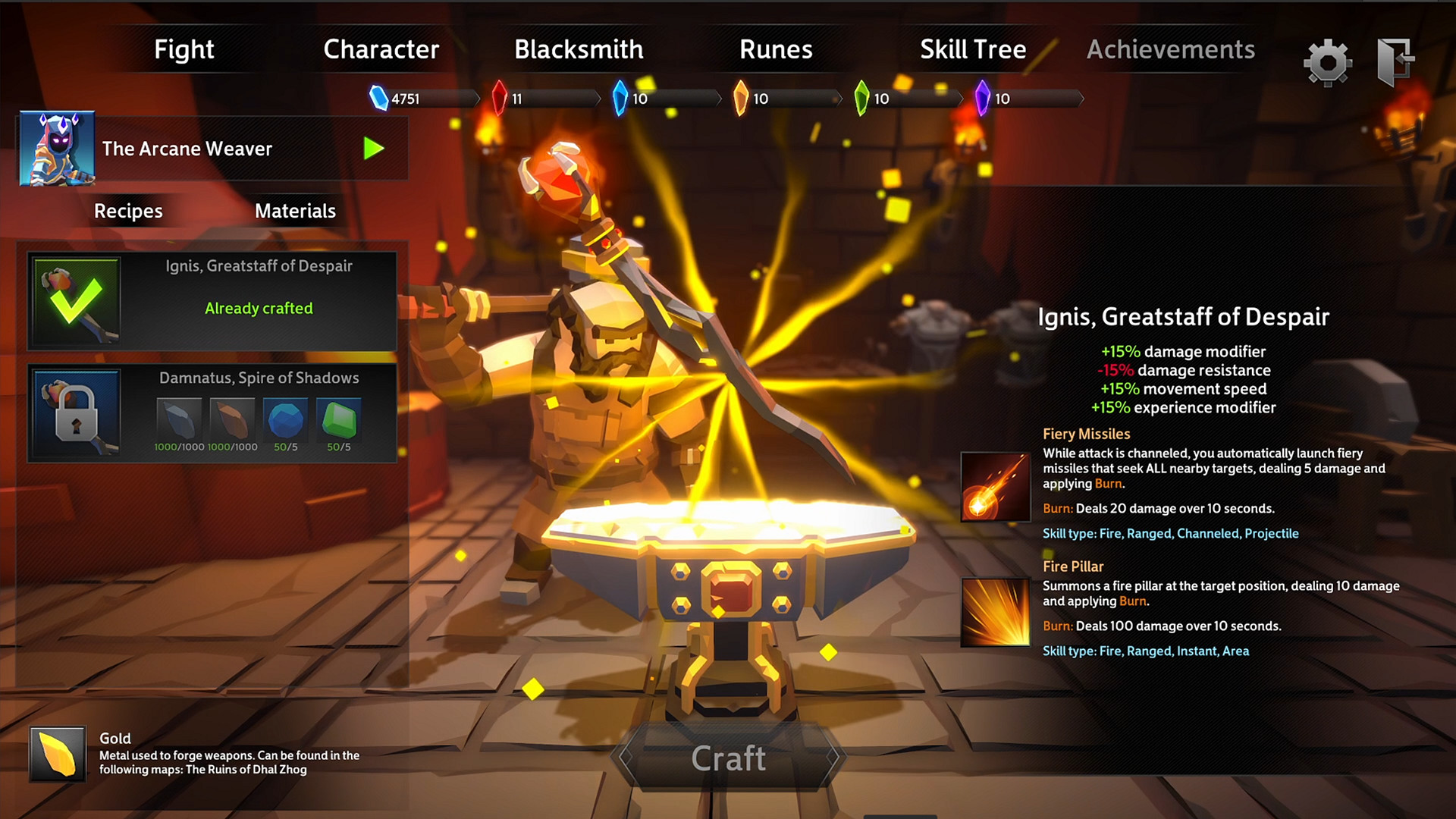
This update has been focused on adding new content for all of the characters through craftable weapons. They change the character's skills, attributes and can drastically change your playstyle. In addition to that, we finally added the so long asked list of power-ups you collected during a run, which can be seen and hovered over in the pause menu! Without further ado, here is the full change list:
Key changes:
- Weapon Crafting: use materials collected in your runs to craft powerful weapons to customise your favourite characters;
- Collect Power Up List: view the power ups you collected in a run, and hover over them in the Pause screen to view details!
- Harvest Minerals: destroy mineral nodes during runs to collect ores and rare gems used for crafting;
- Performance Improvements: enemies and debris are now cleaned from the arena automatically. Debris are cleaned after 5 seconds, enemies will remain for 30 seconds after being slain, to give you a chance to throw them into the void for health;
New spells:
- Heavy Strike (Spellbreaker, new weapon): Slow attack that strikes targets in a large area in front of you causing 40 damage and applying Bleed.
- Ground Slam (Spellbreaker, new weapon): Hit the ground with a powerful strike, causing 50 damage to enemies in a large area in front of you, applying Bleed and Stun.
- Fiery Missiles (Arcane Weaver, new weapon): While the attack is channelled, you automatically launch fiery missiles that seek ALL nearby targets, dealing 5 damage and applying Burn.
- Fire Pillar (Arcane Weaver, new weapon): Summons a fire pillar at the target position, dealing 10 damage, applying Burn and spreading the strongest Burn effects in any of the targets, to all of the targets, refreshing the duration.
- Spread Shot (Lone Hunter, new weapon): Fires 10 arrows in a short-range with a large spread, dealing 15 damage per arrow.
- Disengage (Lone Hunter, new weapon): Throw an icy bomb right in front of you, dealing 60 damage and applying Chilled to enemies, also pushing you back to escape.
Balance changes:
General:
- Slash: damage increased from 35 to 45;
- Unbreakable: this is now a Rare Power Up, up from Uncommon;
- All Damage over time effects removed from enemy skills;
Alexi, the Plaguebearer:
- Health reduced from Tier 2 onwards;
- Poison Bomb no longer applies poison if you step in the area, instead, if will damage you quickly while you stand in the area;
Other changes:
- Frostbolt can now be cast by holding the attack button;
- Fixed issue where projectiles would "pull" enemies towards you, instead of pushing them away as intended;
- Added Restart button to the End Game screen;
- Added Rarity colors to the Level Up screen, making it clearer which power-ups are rare or not;
- Tons of new sounds effects and atmosphere improvements;
- Fixed issue with controller icons for skills being displayed incorrectly;
- Fixed issue where some enemies would die, but stay standing;
- Fixed issue where projectiles could fly in weird angles, now should always go straight;
- Fixed issue where the projectile camera could be forcefully set to be too close. Restoring the camera to defaults will fix the issue;
- Fixed navigation issues in both maps, now enemies should be able to move more smoothly;
- Tons of other small changes including UI, fixes, etc;
We hope you enjoy this update which is the largest update to date, and do let us know what you think in the community or Discord!
Best wishes,
Dev team

Update v0.3.008 is here and now there are different characters to play with! But first, we'd like to thank everyone that has been playing the game once again, the feedback and the support have been invaluable to keeping the game going!
In this patch, the number one focus was adding the Character Selection system and a couple of new characters for you to try out! The full game will have a lot more than these 3 initial characters though, so hopefully, these will give you a good taste of what the other characters can be!
Key changes:
- Character Selection system implemented. Play as the Spellbreaker, the Arcane Weaver or the Lone Hunter!
- Once again major balance changes to better tune the game;
New spells:
- Shoot (Lone Hunter exclusive): Fires an arrow in a straight line, dealing 25 damage to all enemies hit and applying Fragility.
- Rain of Arrows (Lone Hunter exclusive): Shoots multiple arrows at the target location, dealing a total of 80 damage and applying Stun for 5 seconds.
- Arcane Missiles (Arcane Weaver exclusive): While attack is channelled, you automatically fire an arcane missile that seeks a random nearby target, dealing 30 damage in a small area.
- Arcane Explosion (Arcane Weaver exclusive): Summon a large arcane explosion at your position, dealing 20 damage and spreading the strongest Burn, Chill and Doom effects in any of the targets, to all of the targets, refreshing their durations.
Balance changes:
General:
- Void: Now lasts 6 seconds down from 10;
- Void: No longer applies Doomed;
- Void: Pulling radius reduced from 8 to 6;
- Void: Pulling force reduced from 2000 to 1500, and massive enemies should no longer be affected by this spell;
- Flame Wave: Reduced initial damage from 100 to 40;
- Damage from falling into the void has been reverted from 5 back to 20;
- Increased damage done by all enemies starting from Tier 2 considerably;
- Reduced health of all enemies starting from Tier 2;
- Increased the pushback from the Explosive Goblin considerably;
- Units will now spawn up to the intended Tier 5 (instead of stopping after Tier 3);
- Increased the cooldown of Dash from 0.6s to 0.8s;
- Agile: Movement speed increased from 10% to 15% per stack;
- Unbreakable: Damage reduction reduced from 2 to 1 per stack;
- Explosive Reflexes: Damage increased from 20 to 50;
- Explosive Reflexes: Now also applies Burn for 50 damage over 10 seconds;
- Spontaneous Combustion: Chance to proc increased from 5% to 10% per normal hit;
- Touch of Ice: Chance to proc increased from 5% to 10% per normal hit;
- Fateful Strikes: Chance to proc increased from 5% to 10% per normal hit;
- Decimating Strikes: Chance to proc increased from 5% to 10% per normal hit;
Alexi, the Plaguebearer:
- Health and damage increased from Tier 2 onwards;
Other changes:
- Added new sounds effects and atmosphere;
- Fixed issue where the boss would just... commit suicide;
- Fixed issue with spreading effects (Festering Strike and Arcane Explosion), which was working inconsistently;
- Fixed an issue where Poison Bomb would not keep applying stacks to enemies standing on top of it as intended;
- Fixed targeting areas, so that player spells are blue;
The first-ever update v0.2.007 is now out! Before going through the changes, we'd like to say a HUGE thank you to everyone that tested the game so far, the feedback has been awesome and a lot of the changes you see here come from the community!
Here is the full list of changes for this patch. We wanted to focus on the main issues players are having for now regarding balance and usability. Not all of the known issues are fixed yet, but we feel like these changes are crucial and should improve the gameplay considerably while allowing more customisation via the settings menu. Below is the full list of changes:
Key changes:
- Character attacks automatically if Main Skill button is held down;
- Added Camera options in the Settings menu so you can control sensitivity and few other options, exciting!
- Added Resolution options in the Settings menu, almost as exciting as above!
- Common enemies now drop Minor Soulstones, which soon you will be able to use to upgrade your character through the Skill Tree!
New spells:
- Flame Wave: Causes a large explosion at your position, dealing 100 damage to nearby enemies, applying Burn and pushing them back. You are also propelled into the air, but take no damage from the explosion. (suggested by magpy@Discord)
Balance changes:
General:
- Damage from falling into the pit reduced from 20 to 5;
- Festering Strike: Base damage increased from 5 to 50;
- Fire Bolt: Base damage increased from 30 to 60;
- Fire Bolt: Now pushback also affects you (but not the damage);
- Frost Bolt: Base damage increased from 20 to 40;
- Glacier: Base damage increased from 120 to 150;
- Lightning Bolt: Base damage increased from 60 to 120;
- Meteor Shower: Base damage per meteorite increased from 20 to 30;
- Poison Bolt: Damage increased from 250 to 400 over 25 seconds;
- Poison Bomb: Initial damage increased from 5 to 40;
- Poison Bomb: Initial Poison effect damage increased from 80 to 200 over 25 seconds;
- Poison Bomb: Additional Poison stacks damage increased from 20 to 50 over 25 seconds;
- Red Pillar: Increased health by about 20%, and the number of enemies spawned;
- Green Pillar: Increased the rate at which it spawns enemies;
- Reduced experience required to level up by about 10%;
Alexi, the Plaguebearer:
- Health reduced considerably early game (by about half, depending on timing), but increased in later tiers;
- Poison Volley skill will now only be active in Tier 2;
Other changes:
- Fixed an issue where some skills could appear twice, allowing you to have two of the same skill;
- Fixed an issue with aiming projectile skills;
- New visual effects for Goblin Explosive Charge;
- Added "Restart" button to the Pause menu;
The demo for Rogue Soulstone is out now!
The game is currently under heavy development and this is your chance to get a taste of what's to come, and more importantly, to help shape the future of the game! We are listening very closely to feedback, so pitch in, share your opinion, and let's build the ultimate roguelike experience together!
What you can expect from the current demo version:
- Powerful unique skills: Try your luck and make the perfect build with the skills available in the demo;
- Synergise with power-ups: Loads of passive skills and power-ups available to assist you in the void;
- Challenging gameplay: Death is not a rare occurrence in the void...
- A glimpse of the future: The content in the demo is just a tiny bit of whats coming very soon!
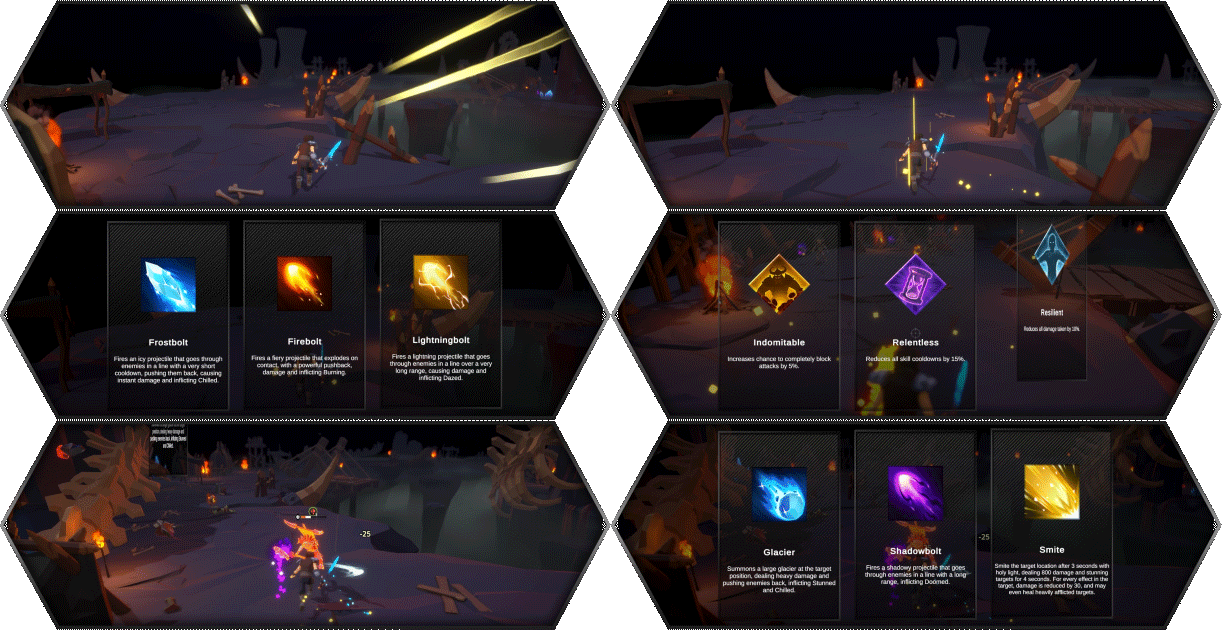
What is under development and will be coming in the following demo updates:
- New characters: With loads of new characters currently in the works, at least a couple will make their way into the demo!
- Early look at the Talents system: Unlock and purchase powerful talents that shape your character from the very beginning;
- A taste of the Skill Tree system: Upgrade your characters with passive skills and stat upgrades that will give you an edge in your quest for the Rogue Soulstones;
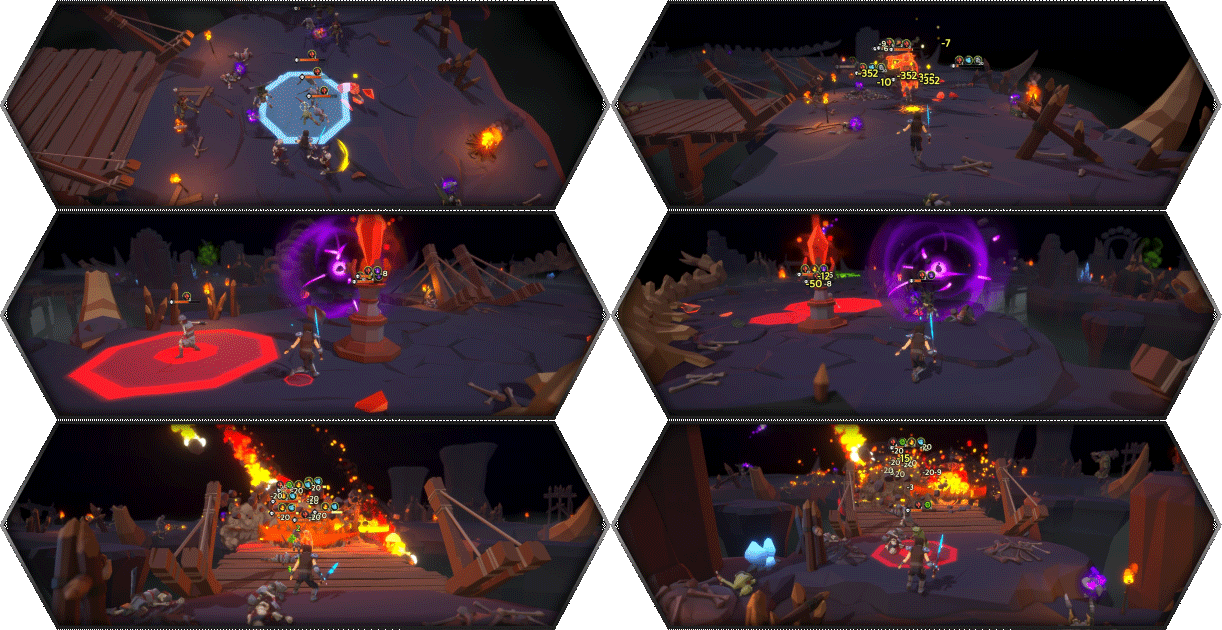
What is coming later to the full version of the game:
- More of everything: New characters, talents, skills, power-ups, Bosses, enemies, scenarios... you name it!
- Challenge system: Are you so powerful not even the warlords of the void can challenge you anymore? Turn on modifiers to make your runs harder and harder for unique rewards;
- Achievements: Show off your skills with badges that only those who appease the roguelike gods can have!
- More to come: We are listening! Is there something you think would be cool? Let us know!
- The dev team
Minimum Setup
- OS: Linux/X11
- Processor: 2.5Ghz or betterMemory: 4 GB RAMStorage: 6 GB available space
- Memory: 4 GB RAMStorage: 6 GB available space
- Storage: 6 GB available space
[ 6408 ]




























[ 5912 ]


[ 1967 ]


























[ 2356 ]




























[ 1101 ]






















[ 1040 ]




























[ 32805 ]



















[ 867 ]





Time left:
356095 days, 7 hours, 22 minutes

Time left:
356095 days, 7 hours, 22 minutes

Time left:
27 days, 15 hours, 22 minutes

Time left:
30 days, 15 hours, 22 minutes

Time left:
31 days, 15 hours, 22 minutes

Time left:
53 days, 7 hours, 21 minutes

Time left:
33 days, 15 hours, 22 minutes

Time left:
5 days, 1 hours, 22 minutes

Time left:
0 days, 9 hours, 22 minutes

Time left:
6 days, 9 hours, 22 minutes

Time left:
7 days, 9 hours, 22 minutes

Time left:
12 days, 9 hours, 22 minutes

Time left:
14 days, 9 hours, 22 minutes

Time left:
18 days, 9 hours, 22 minutes

Time left:
19 days, 9 hours, 22 minutes

Time left:
19 days, 9 hours, 22 minutes

Time left:
4 days, 20 hours, 23 minutes

Time left:
6 days, 20 hours, 23 minutes
Time left:
9 days, 21 hours, 33 minutes

Time left:
18 days, 18 hours, 24 minutes


