




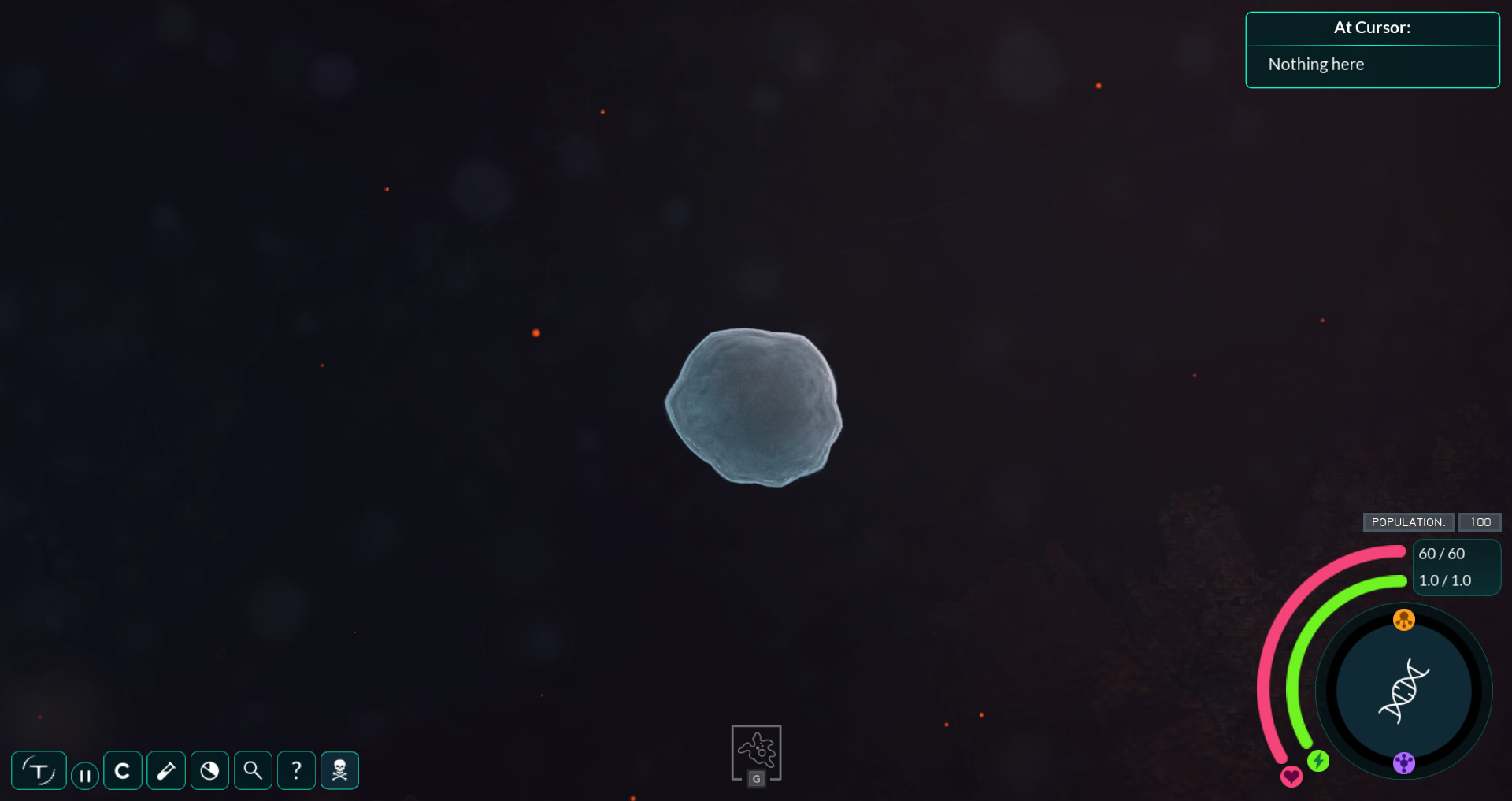

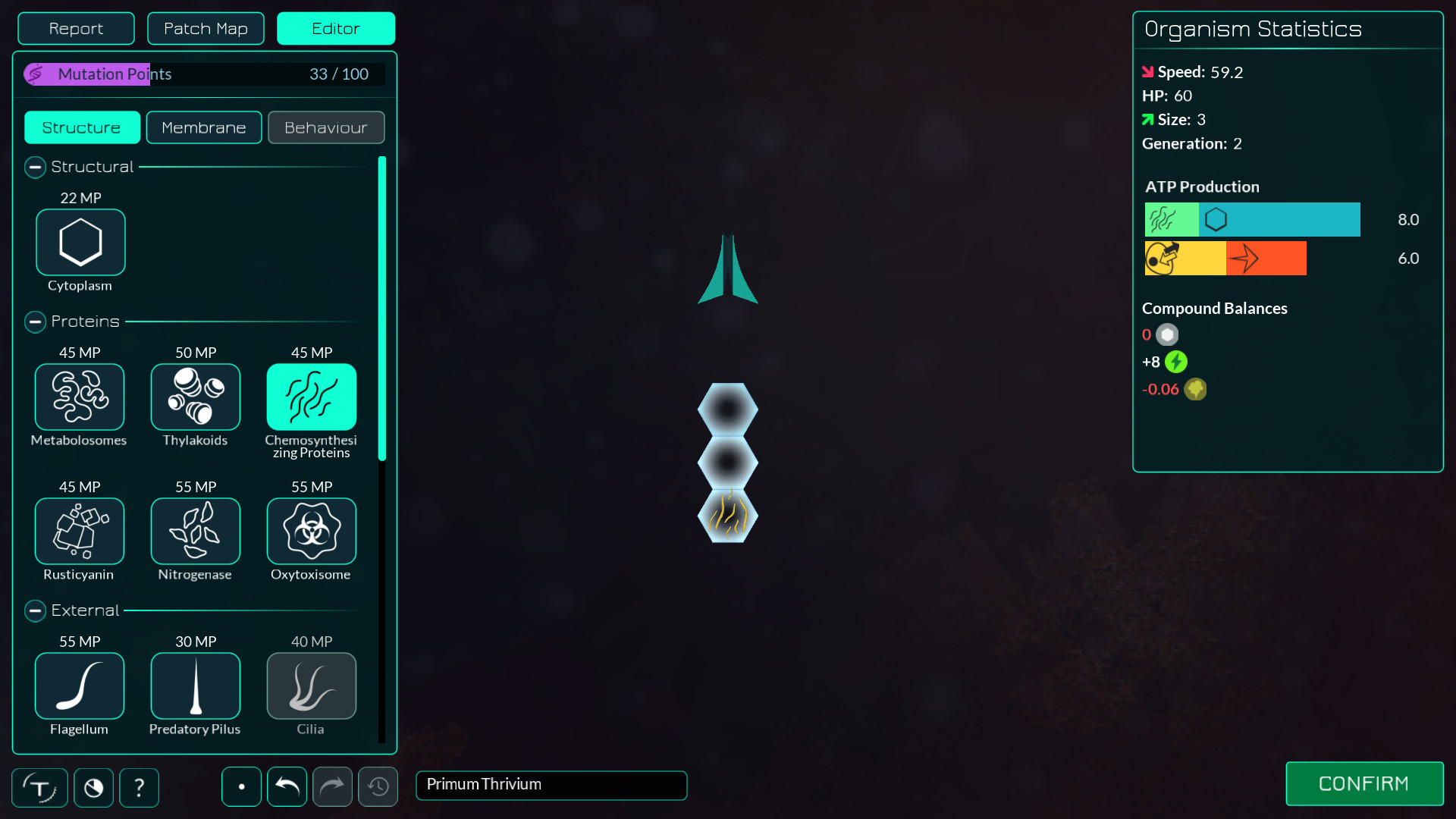


In the Microbe Stage, you control a single microbe or a colony of microbes bound together. You swim through a watery environment to find the resources your cell needs to stay alive and to reproduce. Once you have reproduced, you enter the editor, where you can review how well your species and others are surviving, move to new biomes, and modify your species. Add new organelles, change your membrane, and change your cell's visuals. Your goal is to become a more complex lifeform by first evolving the nucleus to become a eukaryote, then using binding agents to form cell colonies, the precursor to the first multicellular lifeforms.
Current key features:
- Control an individual member of your species and survive the environment
- Predate on other species, use photosynsthesis or scavenge for resources
- Edit your species to make it more successful
- Compete with other species emerging on your planet via an evolution simulation
- Explore different biomes
- Fight other cells with multiple cellular level weapons
- Try different gameplay styles by specializing in different energy sources in subsequent playthroughs
- Learn about biology by using real compounds, organelles or parts inspired by real science
- Spread your species via the biome map
- Review and plan future actions by looking at population simulation results and graphs
- Learn the basics of the game with a light interactive tutorial
The major goals of Thrive are to create engaging, compelling gameplay that respects our players’ intelligence, and remain as accurate as possible in our depiction of known scientific theory without compromising the former. Thrive is an open-source project, and anyone with game development skill is welcome to join our team. The game uses the open-source Godot engine with the C# programming language.
If you don't have game development skills, you are still welcome to join our fan community. We would love to have you along for the long ride!
Welcome all to this very special devblog celebrating the release of Thrive version 1.0! This release marks the completion of the Microbe Stage, the first stage of the 9 planned. The Microbe stage will continue to be supported with balancing and bug fix updates, and volunteers are welcome to continue to make contributions to it. But our main development efforts will now focus on our second stage, Multicellular.\n\nIn the time since version 0.9.0, we\'ve mainly been focused on fixes, adjustments and balancing to make this release the best it could be. But that still included some more notable features. This includes: new map events to mix up compound amounts, a visualisation of your population on the patch map, a slight re-work of the functioning of the pilus and more of each species\' characteristics being taken into account by our auto-evo system. Graphically, a big bug was fixed that made all our release versions less bright than intended, and improvements to the visuals of the terrain chunks.\n\n\n\nRead on for more details, or play the new version now.\n\n
Reflecting on the Journey
\n\n \n\nAs those who have been with us the longest know, Thrives development has gone through cycles of stagnation, highs, lows - and ultimately - grit. For a significant portion of our projects history, there was uncertainty on whether we would reach this point in the first place.\n\nThe earliest times of Thrives history are before the time of even most of the current developers, but it was an era where competing visions and ideas met intense manpower limitations. Thrives scope grew to an otherworldly size, a wishlist of a game aiming to represent something as wonderful as the endless forms of life.\n\nFrom this point, development was refined until a more centralized development team was organized. From this first generation of development onwards, the fundamentals of Thrives Microbe Stage were hammered out. And after several years and successive development generations, it became obvious that Thrive as a game can genuinely be fun and true to its goal as a scientifically accurate evolution simulator. Numerous eras of development have passed, each with their own contributors, challenges, and successes.\n\nWhat can be said is that the current development team stands on the shoulders of giants. And that everything is possible only through the support of our beloved community. Without you, the reader, Thrive could have easily fizzled out years ago. And now - through collaboration, community, and the efforts of hundreds of volunteers, working towards an often-times impossibly distant horizon - we welcome a feature-complete Microbe Stage.\n\n
Terrain Visual Improvements
\n\n \n\nThe terrain chunks have been given baked-in ambient occlusion maps, which gives them more visual depth. Some chunks have also been made appropriately shiny. For example the chunk of pyrite on the right, also known as fool\'s gold.\n\n
New Events
\n\n \n\nSeveral new patch events have been added. Runoff in coastal patches and upwellings in ocean patches increase the the amounts of a selection of compounds. Dilution, on the other hand, reduces the amount of compounds available. This makes the world more dynamic, as compounds you are relying on may suddenly become less common, even as other opportunities suddenly arise.\n\n
Additional Features
\n\n- \n
- Overhaul of the MP calculation system, eliminating many bugs and exploits.\n
- Added player population visualization dots on the map.\n
- Auto-evo now considers the usage, collection and production of Ammonia and Phosphate.\n
- Ammonia levels are now dynamic, consumed by life, and produced by species with the right parts.\n
- Thermosynthesis has been re-implemented as producing glucose instead of ATP, making it a much more viable energy source.\n
- Auto-evo now evolves and calculates for many more things, such as different toxin types, turning speed, sprinting speed and health.\n
- Added graphics preset options.\n
- The pilus has been reworked and now deals continuous damage on contact.\n
- Microbe movement speed now impacts how loud the movement sound is for the cell\n
Whats Next
\n\nAs said before, this release concludes the main development of the Microbe Stage. Finally, we can look to the future, and are shifting focus to the Multicellular Stage. The good news is that the next Stage makes use of a lot of the same mechanics that the Microbe Stage does. With that, we hope that total development on the Multicellular Stage will only take one year. Which would mean that in about one year, we would be announcing the release of 2.0, and the beginning of development on the Macroscopic Stage. Let\'s work to make that happen!\n\n\nA bit different from the usual, our developer Thrivestream will be on Saturday instead of today on the release day. We\'ll celebrate the release on the stream, but also answer the usual question of what\'s coming in the next releases. You can visit our feedback thread to give your thoughts on this release or comment below.\n\nWatch the stream:\n\n\n\nPatch Notes
\n\n- \n
- Fixed a massive error with the game being much darker than intended. This went unnoticed for a long time as the game looked normal when debugging, but much darker only in a release version.\n
- Made some terrain chunks shiny\n
- Fixed fun screen filter effects not working at all\n
- Fixed microbe background particles never being freed thus they kept stacking infinitely\n
- Fixed major problem with dying on easy mode giving population rather than taking it away\n
- Player species spawn rate now immediately updates instead of only updating after the next editor cycle\n
- The food chain tab is now centered on opening and can be dragged around better\n
- Fixed preview microbe data checks being incorrect, which caused errors in the multicellular editor\n
- Fixed a rare error when trying to generate small worlds that prevented specific seeds from working\n
- Fixed a bug in the logic for making rotating an organelle free, now it should correctly detect organelles rotated in-place and make that free\n
- Fixed population indicator circles using a low resolution texture\n
- Fixed the banana chunks not appearing in the banana biome\n
- Added extra error checking to the feature for continuing as another species on extinction so that it cannot suggest picking the current species again to play as\n
- Fixed error in multicellular on editor exit when cell layout repositioning caused new cell overlaps. This slightly alters all organelle repositioning logic, even for the microbe stage.\n
- Fixed errors triggered in multicellular editor in certain cases when the cell editor was not initialized\n
- Fixed the button in the options menu for showing tutorials in the current playthrough not always updating correctly\n
- Fixed warnings about the extinction box GUI anchors\n
- Background task errors are now forwarded to the GUI unhandled errors popup\n
- Optimized the museum species list refresh to only update deleted or added items instead of all\n
- Tweaked the prototype stage world environments to make sure that they aren\'t just a single change away from a release mode brightness bug\n
- Made MP amount update after duplicating a cell type in case there was some inconsistency\n
- Adjusted a few comments and tweaked the now unused save upgrader to do some issue clean up\n
- Updated some of our setup instructions related to Visual Studio Code\n
- Updated gdUnit4 to 6.0.3\n
- Updated System.Text.Json from 10.0.0 to 10.0.1\n
- Updated System.IO.Hashing from 10.0.0 to 10.0.1\n
- Updated our code checking tools\n
- Updated translations\n
Minimum Setup
- OS: Ubuntu 20.04 or latest Fedora version
- Processor: AMD Ryzen 3 3300UMemory: 4 GB RAM
- Memory: 4 GB RAM
- Graphics: Intel HD Graphics 530
- Storage: 1 GB available space
Recommended Setup
- OS: Ubuntu 20.04 or latest Fedora version
- Processor: AMD Ryzen 5 2600X or Intel equivalentMemory: 8 GB RAM
- Graphics: GeForce GTX 970 or AMD equivalent
- Storage: 5 GB available space

[ 6374 ]






























[ 5785 ]


[ 751 ]




























[ 2194 ]






























Time left:
356103 days, 17 hours, 15 minutes

Time left:
356103 days, 17 hours, 15 minutes

Time left:
8 days, 1 hours, 15 minutes

Time left:
36 days, 1 hours, 15 minutes

Time left:
39 days, 1 hours, 15 minutes

Time left:
40 days, 1 hours, 15 minutes

Time left:
13 days, 11 hours, 15 minutes

Time left:
0 days, 19 hours, 15 minutes

Time left:
1 days, 19 hours, 15 minutes

Time left:
8 days, 19 hours, 15 minutes

Time left:
14 days, 19 hours, 15 minutes

Time left:
15 days, 19 hours, 15 minutes

Time left:
20 days, 19 hours, 15 minutes

Time left:
26 days, 19 hours, 15 minutes
Time left:
3 days, 5 hours, 15 minutes

Time left:
11 days, 1 hours, 16 minutes

Time left:
13 days, 0 hours, 16 minutes

Time left:
18 days, 7 hours, 26 minutes


