



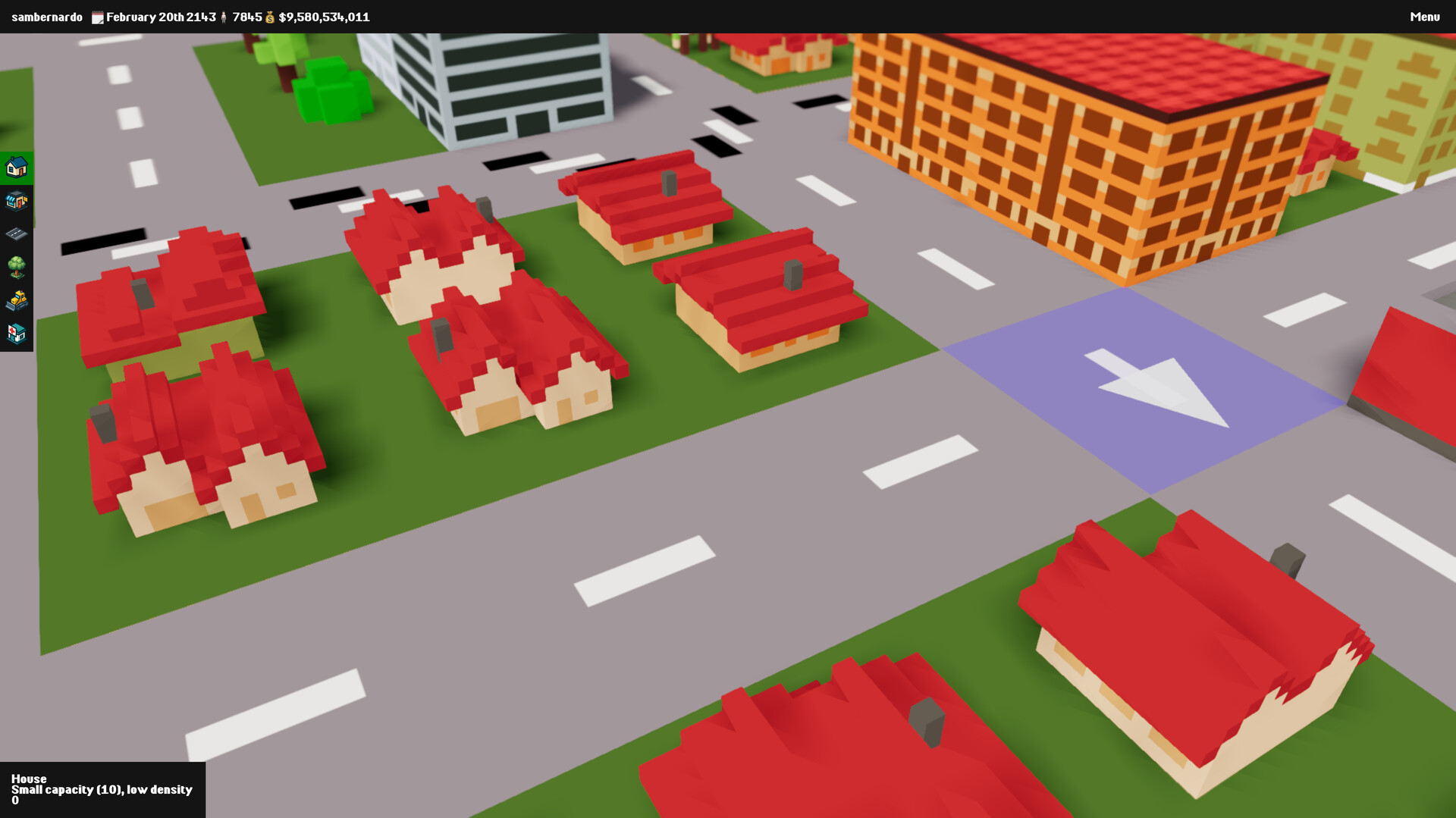
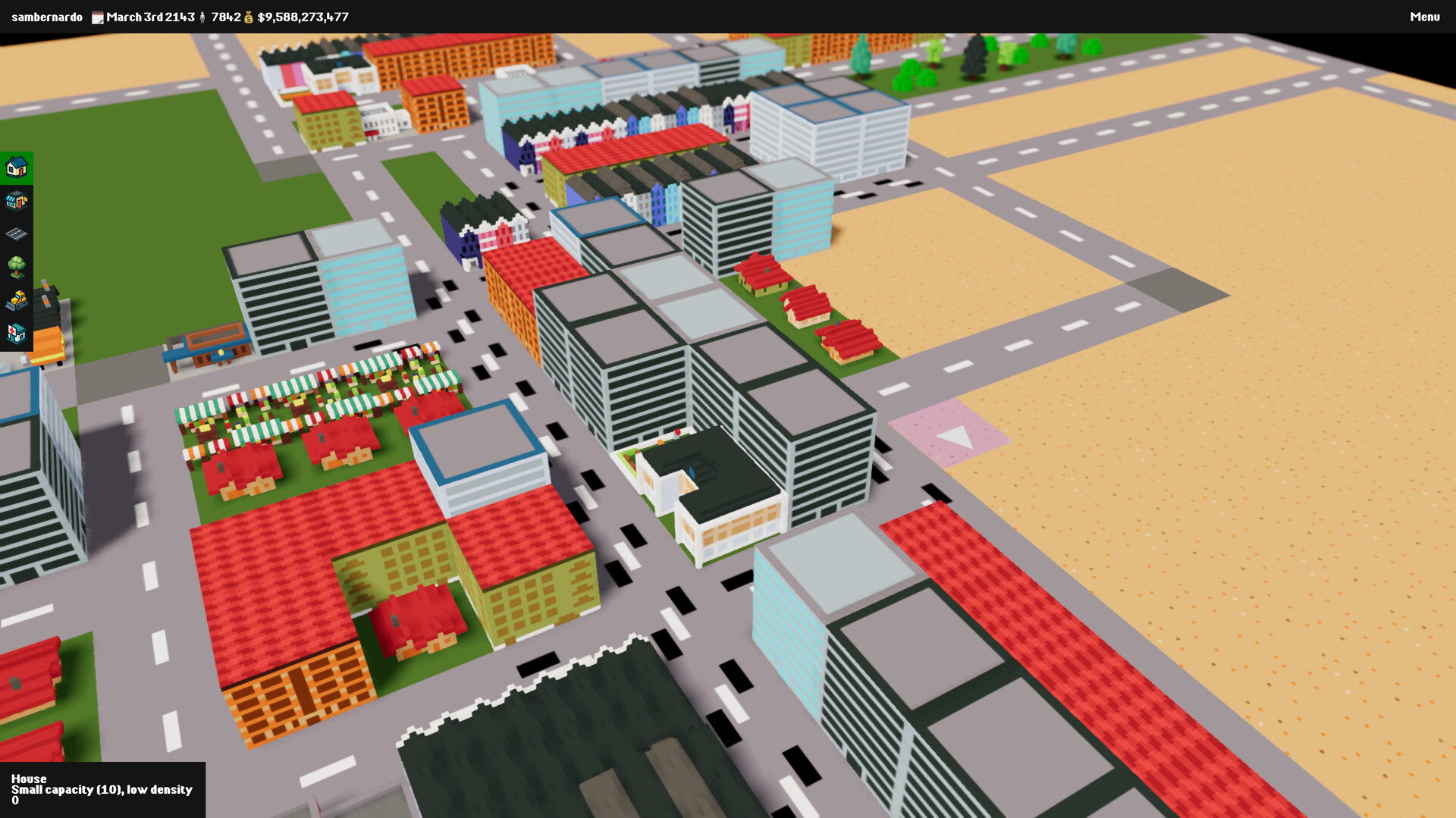
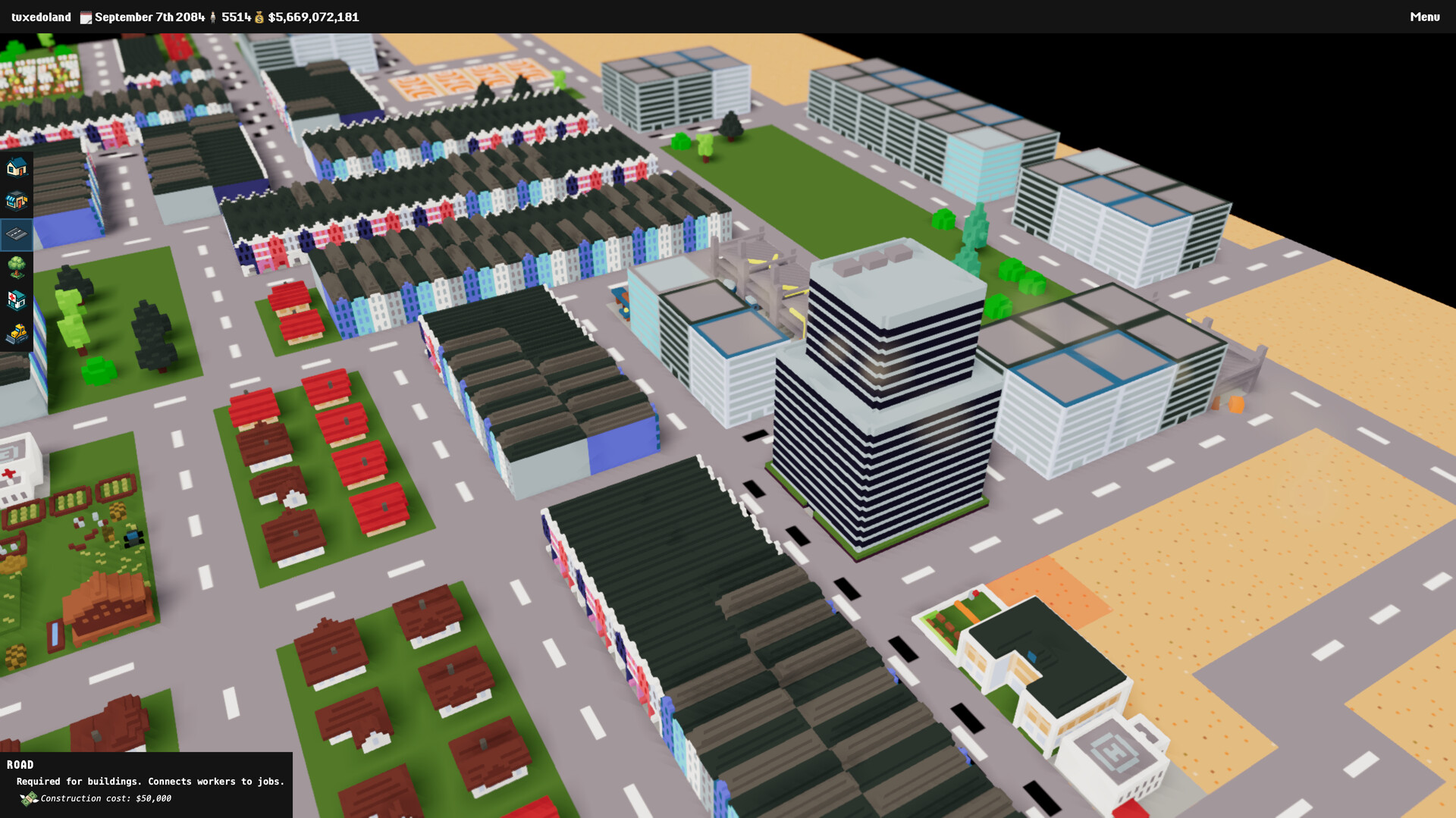
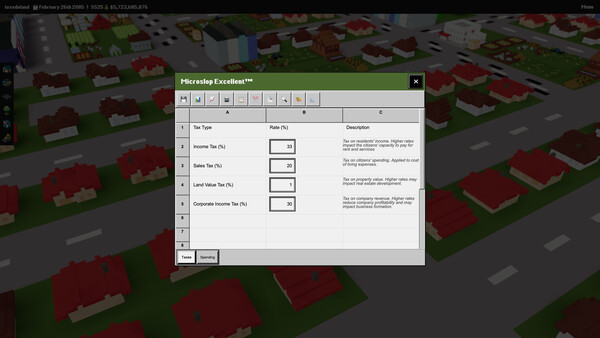
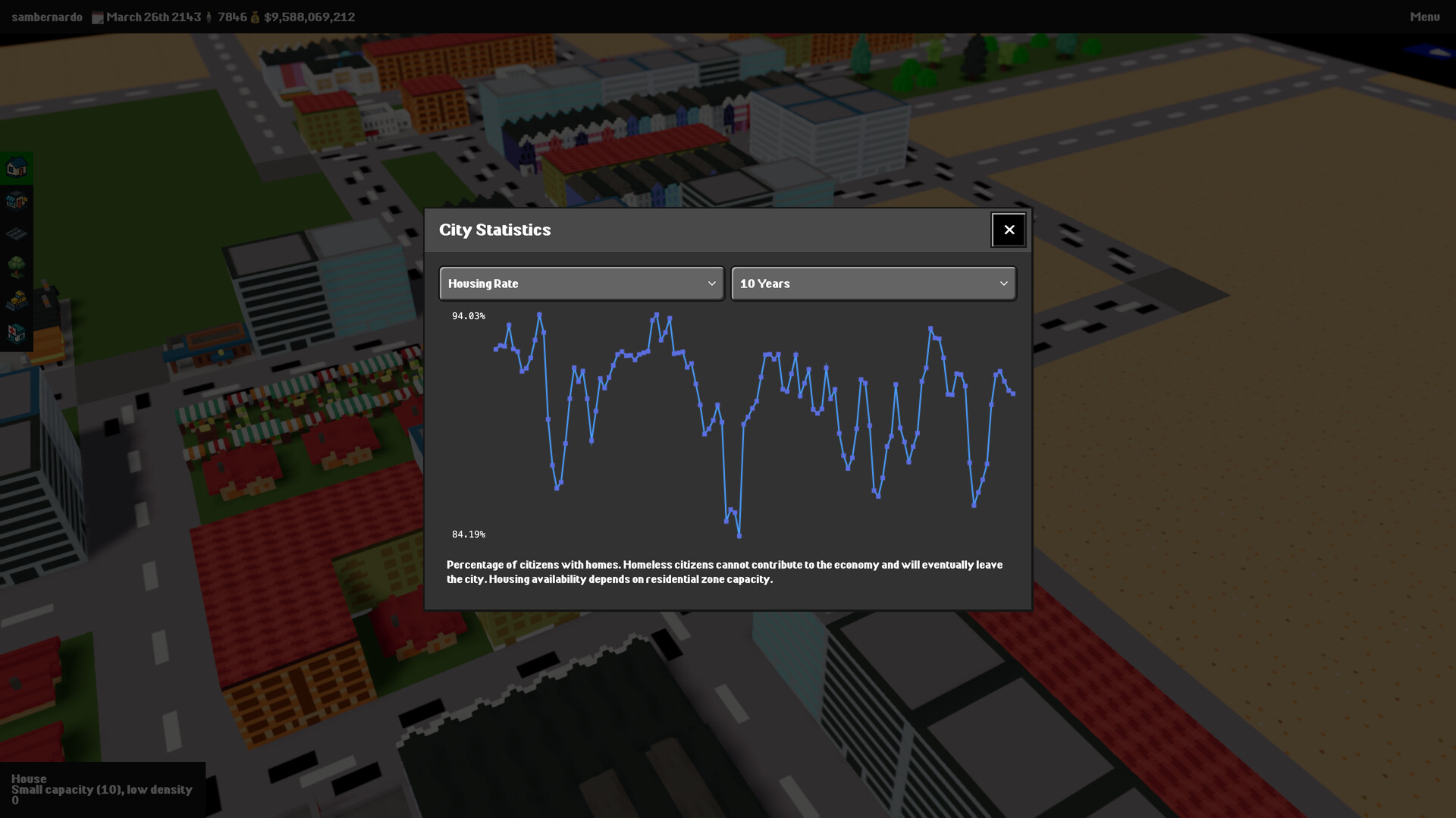
A simple city building game with a not-so-simple simulation engine.
In Microlandia, you are the town mayor. You build roads, you zone terrain for commercial or residential use, and you manage taxes and budget.
With simple voxel-based graphics inspired by the classics like the original 1980s SimCity game, but with a brutally detailed simulation behind the hood. Life of your virtual citizens is rich with complex details based in true life statistics and studies:
- 💀 If citizens get sick and there's no hospital capacity, they die.
- 💼 When they can't drive to work because there's no road or excessive traffic, they get fired.
- 📉 When companies don't make ends meet, they go bankrupt, and everyone is fired.
- 🤑 When the supply of housing is scarce, landlords get greedy and increase rents.
- 👩❤️👩 Citizens fall in and out of love and can have children.
- 🚧 Roads cost thousands of dollars per kilometer, and it's a huge investment for the city.
- 💸 On the other hand, a housing building will be paid for by the private sector, and it's virtually "free".
- 🥷 When citizens have no job for some time, they consider a career in the criminal underworld.
- 📈 Simulation mechanics are carefully modeled after publications like World Bank Open Data, U.S. Bureau of Labor Statistics, U.S. Environmental Protection Agency, National Equity Atlas, Center for Urban Future and more.
The objective is to build a good enough simulation so it can provide real insight into the social, economic, and environmental challenges of modern life.
🕹️ Partial Controller Support
🎮 Full Controller Support
- [0 B]
We spend most of our time staring at the surface, roads, lights, a pleasing grid, then we act surprised when the economy behaves like an animal. Version 1.4 is about removing that comfort blanket: more visibility into price, profit, and the small accounting lies that quietly become big disasters.\n
[img src=\"https://cdn.cloudflare.steamstatic.com/steamcommunity/public/images/clans/45820432/ec14871b0b9c005f27bc230a8a551f244c984938.png\"][/img]
Economy, money, and the parts you were previously guessing
New Business Info screen: inspect company performance directly, check cash flow, sales and revenue data of any company in your city, accessible with a new button available in the inspector dialog.
[/*]New Land Value map: now you can see a heatmap of property prices that shows you where land value tax actually comes from.
[/*]Improved company AI: Firms are greedier than ever, make saner hire and fire decisions using cashflow forecasts and are generally better at avoiding bankruptcy.
[/*]
Transport, buses, and the uncomfortable arithmetic of movement
Improved UI and management of Bus fleets and bus stops
[/*]Improved the transport economic simulation: Transport data now accounts precise ticket revenue and parking lot usage. Parking lot usage now can also be inspected using the query cursor.
[/*]Buses are visible in traffic, bus routes now show buses driving through the city instead of ghosting out.
[/*]
Fewer bugs, and fewer immortal toddlers
Fixed family and age calculation issues, families no longer leave dependent children behind, or move out with adult dependents.
[/*]Fixed age group errors that caused bizarre side effects like immortal citizens and 3 year old immigrants. Arrivals to the city now always are in the working adult age group, and cities have more realistic demographic distributions.\n
[/*]
[img src=\"https://cdn.cloudflare.steamstatic.com/steamcommunity/public/images/clans/45820432/fe56a2039c47571d4c66c24465ddbc99ca42490f.jpg\"][/img]
Parks, neon lights, and the tyranny of grass
Night Mode: toggle with N key or in Settings, a cosmetic dark look so you can admire the city lights while the simulation keeps grinding exactly as before.
[/*]Parks now have stricter rules, park features require grass first, so you build a park instead of decorating bare dirt.
[/*]Park features reclassified: Hot Dog, Lucky Cat, Chess Corner, Monolith are now park features, not buildings.
[/*]Park scoring is more honest: all park features count toward the park index, not just fountains and playgrounds.
[/*]New achievement, The Botanist: reach a perfect park score.
[/*]New tree models at correct world scale, the forest stops lying about its size.
[/*]
New buildings, gifts, and curated absurdity
New build: Diner, with 100% roadside americana vibes, because every city needs a place where time does not move.
[/*]New gift buildings: Modern Art Museum and the Sakura Tree, for beauty, confusion, and pink serenity.
[/*]New museum build: The Lost and Found Museum, locked until your city reaches 1 million bus rides, an equally amusing and confusing exhibition of items lost and found in buses.
[/*]
Interface clarity and narrative texture
Improved demand points UI, now signals when demand is stagnant due to oversupply, with better help content to get you unstuck.
[/*]More newspaper content, refined and expanded, with more commentary straight out of events from the simulation.
[/*]
Balance and stability
Many small rebalances, park costs, construction times, achievements, and building capacities tuned.
[/*]Linux launch issues fixed, for players who prefer their mayorship with a penguin.
[/*]
A city is a beautiful, but insane machine that survives always in homeostasis and always in chaos. In 1.4 you get a little less narrative, a little more reality, the structures of everyday life exposed, greed companies, economy that doesn\'t forgive, even the broke. The night mode is a pleasant anesthesia; use it, but do not confuse ambience with robustness.
Microlandia 1.3 is what happens when you stop worshipping tidy spreadsheets and let the messy world leak into the model. The normal stays boring, the tails get teeth.
[olist]Public safety becomes real\nPolice officers are now agent-simulated. Police stations will need to hire citizens to function, so an understaffed precinct loses effectiveness, and a precinct that hires nobody is just an expensive monument to wishful thinking.
[/*]Gamepad and Steam Deck feel native\nController support is meaningfully improved across dialogs and map interactions, so playing with a gamepad, or on Steam Deck, stops being an exercise in patience. Rendering optimizations also reduce battery drain and make crowded cities feel smoother.
[/*]Crime gets an appetite\nCriminals can now attempt armed robberies, not just mug citizens. The newspaper also tells better crime stories, with outcomes that reflect reality, what happened, who got caught, who slipped away, what kind of crime it was.
[/*]Housing crisis stops being abstract\nUnhoused citizens now appear in the city. The unlucky ones will camp in empty lots and parks, giving you visual proof that a housing shortage is not just a number in a spreadsheet.
[/*]Growth and approval systems reworked\nBuildings with culture aura now plays a major role in immigration, cities with more culture points pull grow faster. Also, approval points are now awarded every month according to the happiness index, so leveling up a city requires constant attention to popular demands.
[/*]Transit clarity, less guesswork\nMap mode warns you when buses are not attached to bus stops. The fleet dialog now shows real ridership numbers, instead of the count of buses in use. Buses also accumulate mileage even when running empty, because reality charges you even when nobody is watching.
[/*]New things to build\nNew retail building: Supermarket. New park amenity: Pergola.
[/*]Visual polish\nCar traffic animations are improved, the city reads better at a glance.
[/*]Localization grows up\nTranslations are improved across languages. German, Spanish, and French are now officially supported, with Polish coming soon.
[/*][/olist][p align=\"start\"]Microlandia is not trying to be a postcard, it is trying to be a detector. Version 1.3 pushes the simulation toward the uncomfortable parts, crime that adapts, institutions that require staffing, growth that depends on what people actually value, and crises you can no longer hide behind a menu. Build your city like a cautious skeptic, then watch it punish overconfidence, and reward the rare mayor who plans for the worse, not the average.[/p]Microlandia 1.2 is the kind of update that exposes the cowardice of tidy abstractions. Transportation is not a menu choice, it is a battle over asphalt, and the loser is always the commuter who thought the system was polite. This version leans into that reality, it makes mobility visible, costly, and consequential. Bus network, rebuilt from the pavement up.
[img src=\"https://cdn.cloudflare.steamstatic.com/steamcommunity/public/images/clans/45820432/ceaaf487e302ddcb9ab995589c24475327b641a0.png\"][/img]
[img src=\"https://cdn.cloudflare.steamstatic.com/steamcommunity/public/images/clans/45820432/071253082fb222a6539d2eb69562f51b032cec0d.png\"][/img]
You can now design bus routes directly in the map view.
[/*]For now, buses run on one bidirectional route; more routes will come later.
[/*]Buses and cars are visible on the map with new animations, reflecting the actual flow of vehicles on roads.
[/*]The bus system now has more realistic fleet usage and operating costs.
[/*]Buses and cars now compete for road capacity, commuters interfere with each other, and your planning errors become expensive.
[/*]Traffic failures on commutes to work, problems with bus capacity or lack of parking become productivity losses for the firm and companies cannot operate without a good transportation network.
[/*]
Controls that do not fight the player
Reworked Xbox controller support.
[/*]Steam Deck experience improved, with fixes aimed at making it feel native, not tolerated.
[/*]
Localization, imperfect in the honest way
New playable languages: French, German, Polish, Spanish, alongside English.
[/*]Translations are beta, some text remains in English, some needs polishing.
[/*]Community effort, with special thanks to EyZo and Purfle, and an open call for more translators via the Discord.
[/*]
Smoother play, less wasted machine
Lower memory usage.
[/*]Higher framerate across platforms thanks to improved rendering.
[/*]
Version 1.2 makes the city less decorative and more true, which is to say, more fragile, more legible, and more instructive.
Howdy builders,\n\nIn this release, the city becomes a little more like the real world: The job market has deeper impact in the dynamics of the city, unemployment might be an opportunity for some, and firms are sometimes born out of fear.
[img src=\"https://cdn.cloudflare.steamstatic.com/steamcommunity/public/images/clans/45820432/63405d4238d54c4e8b131341001fcf4be0a0a999.png\"][/img]
Here is what changed.
[olist]Entrepreneurs out of unemployment
When citizens lose their job and still have some capital, they now sometimes do what real people do when the system forgets them. They start firms.
No magical spawned company anymore. A person, once unemployed, may decide to risk their savings, open a business, suffer a few months of revenue volatility, and only then begin to hire others. Firms are now stories that begin in fear and necessity, not abstract entities that appear from the void.
[/*]Job Market panel, or how to stare at the labor maze\nA new Job Market information screen appears in your civic tool kit, with three views of your city\'s job market:
The job board shows every open position in the city, line by line, so you can see whether your economy is starving for workers or suffocating them.
[/*]The statistics view tells you which industries and professions are hiring, so you can finally see that unemployment is not one number, it is a misalignment of skills and demand.
[/*]The feed shows what citizens are posting in the \"Locked In\" social network, a real time view of who just got hired and who\'s starting a company.
[/*][/*]Transportation in the census, or who really moves your city
The census now has a Transportation slide. It records every trip taken by every citizen, sorted by mode.
You will see how many people drive, how many walk to work, and how many choose the bus. This is not cosmetic. It reveals whether your road network is a genuine necessity or an expensive monument to your own illusions about mobility. Congestion, pollution, and access begin in these counts.
[/*]The boring details that only matter when they break
Visual behavior under Linux is smoother, gamepad controls are more reliable, camera movement is less clumsy, and a collection of small bugs has been squashed. Construction times, approval points and costs have been rebalanced for some buildings.
[/*][/olist]You now have more ways to observe how decisions propagate through employment, transport, and construction. The city will surprise you more often, which is the entire point.
Minimum Setup
- OS: Ubuntu 22.04 or equivalent
- Processor: Dual-core CPU. 2.0 GHz (Intel Core i3-4xxx / AMD equivalent or better)Memory: 8 MB RAM
- Memory: 8 MB RAM
- Graphics: Integrated graphics with OpenGL 3.3 support
Recommended Setup
- OS: Ubuntu 24.04
- Processor: Quad-core CPU. 2.5 GHz (Intel Core i5-7xxx / AMD Ryzen 5 or better)Memory: 16 MB RAM
- Graphics: Dedicated GPU with 2GB VRAM

[ 6380 ]




























[ 5876 ]


[ 1265 ]





























[ 2018 ]






























[ 986 ]






























Time left:
356101 days, 14 hours, 16 minutes

Time left:
356101 days, 14 hours, 16 minutes

Time left:
5 days, 22 hours, 16 minutes

Time left:
33 days, 22 hours, 16 minutes

Time left:
36 days, 22 hours, 16 minutes

Time left:
37 days, 22 hours, 16 minutes

Time left:
11 days, 8 hours, 16 minutes

Time left:
6 days, 16 hours, 16 minutes

Time left:
12 days, 16 hours, 16 minutes

Time left:
13 days, 16 hours, 16 minutes

Time left:
18 days, 16 hours, 16 minutes

Time left:
20 days, 16 hours, 16 minutes

Time left:
24 days, 16 hours, 16 minutes

Time left:
4 days, 5 hours, 31 minutes

Time left:
8 days, 22 hours, 17 minutes

Time left:
10 days, 21 hours, 17 minutes

Time left:
16 days, 4 hours, 27 minutes


